


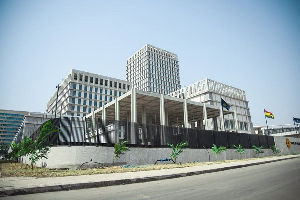
 Bank of Ghana Headquarters
The Bank of Ghana (BoG) has urged journalists and media owners to support efforts to reset the economy through accurate, balanced and responsible reporting.
The call was made by Dr Johnson Asiama, the Governor of the BoG, at a two-day residential training workshop organised by the Private Newspapers and Online News Publishers’ APRINPAG BoG Mediassociation of Ghana (PRINPAG) at Solikope in the Ada East District.
The BoG-supported workshop is aimed at strengthening financial and economic literacy among publishers and editors and improving the media’s capacity to interpret complex economic issues.
Delivering the Governor’s address, Dr Francis Yao Kumah, Advisor to the Governor, said Ghana entered 2026 with improved macroeconomic indicators.
He said inflation declined from 23.8 per cent in December 2024 to 5.4 per cent in December 2025, while conditions in the foreign exchange market had stabilised.
Dr Kumah said gross international reserves stood at US$13.9 billion, equivalent to 5.7 months of import cover.
He said resetting the economy required resetting expectations, institutions and behaviours, and that the media played a critical role in shaping public understanding.
“Our expectation is not compliance but responsibility, with emphasis on accuracy, balance and context,” he said, adding that the Bank remained committed to openness and engagement with the media.
Dr Kumah said monetary and financial policies were often technical, and that inaccurate or poorly contextualised reporting could affect public confidence and expectations.
He said a responsible and well-informed media helped counter misinformation and contributed to economic stability.
Outlining the Bank’s priorities for 2026, Dr Kumah said policy would focus on consolidation and discipline.
He mentioned four priority areas: reforms in the foreign exchange and money markets; resilience in payments systems and digital finance; preventive supervision with emphasis on governance and early risk identification; and clear, evidence-based policy communication.
Dr Kumah urged journalists to enhance their understanding of economic issues and uphold integrity and accountability in reporting.
He cautioned that incomplete or decontextualised reporting could heighten uncertainty, particularly in the foreign exchange market, and advised journalists to verify information through the Bank’s official channels.
Dr Kumah announced initiatives to strengthen media engagement, including expanded training programmes, a regular Editors’ and Producers’ Forum, and the Governor’s “Economic and Financial Story of the Year” Award.
He said the award would sponsor the winning journalist to attend the International Monetary Fund and World Bank Meetings.
Dr Kumah said the Bank’s communications team would continue to support newsrooms with clarifications, briefings and access to official data.
Felix Kwakye Ofosu, Minister for Government Communications, said the media played a key role in sustaining democracy and holding governments accountable.
He said Ghana’s media landscape remained vibrant, although some individuals perceived the media as a nuisance.
Ofosu said President John Mahama had directed a meeting between media practitioners and security agencies to address incidents of media brutality.
The minister urged the media to continue to innovate and remain principled, and pledged government support for the private media sector.
Jeorge Wilson Kingson, Executive Secretary of PRINPAG, said the programme was timely, given the current economic conditions.
He said the sessions would cover monetary policy, fiscal reforms, debt management, digital finance, and the sustainability of media businesses in the post-debt restructuring period.
Kingson said the workshop formed part of a broader roadmap to reposition PRINPAG members as informed and credible contributors to national development.
