


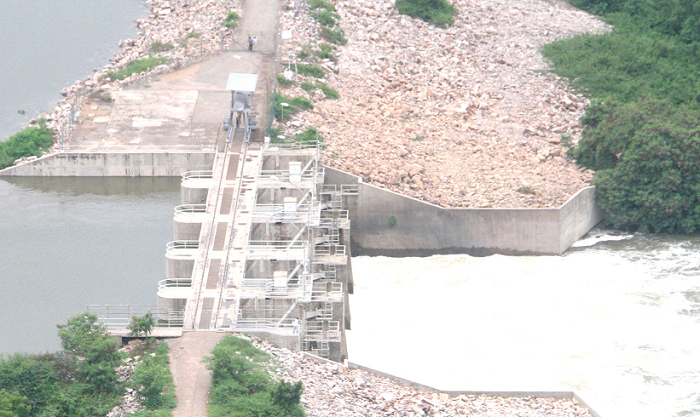
The Ghana Water Limited (GWL) has clarified that the water released from the Weija Dam on Tuesday, September 8, was only a trial of the spill gates, with the actual spillage beginning at 6 am on Wednesday, September 9.
Head of Public Relations and Communications at GWL, Stanley Martey, said the trial was conducted to ensure the dam’s hydraulic spill gates were functioning properly before the commencement of the actual spillage.
Speaking on Joy FM’s Super Morning Show on Wednesday, Mr Martey explained that although water was seen being released from the dam on Tuesday, the exercise was not the official start of the spillage.
“The actual spillage has begun this morning at 6 am,” he said.
Mr Martey’s clarification followed reports that the spillage had already started on Tuesday, despite GWCL’s communication indicating that it would begin on Wednesday.
When asked what had changed, he explained that the difference was largely technical.
“Yesterday [Tuesday] we tested the gates, and everything, but actual spillage started this morning,” he said.
He said hydraulic spill gates need to be tested before they are fully deployed to ensure they can operate effectively when required.
“It’s just a trial for the spill gate. As I said, they are hydraulic gates,” Mr Martey explained.
“So we need to try them because sometimes they get stuck. Sometimes it’s time that we need them to operate.”
According to him, testing the gates ahead of the actual spillage is necessary because a malfunction at the point when the gates are urgently needed could create problems.
“Before anything, you need to do some trials, something like that, so that you are sure that any time you want to open a gate, you want the gate to be functioning effectively,” he said.
Mr Martey also explained why the dam is experiencing another spillage this year, following the previous exercise in May.
He said there was no rule requiring the Weija Dam to spill only once a year, explaining that the frequency depends largely on the amount of water flowing into the dam from upstream.
“One thing, it’s not only like that, because every year and what it comes with, but there are certain years that we spill throughout the year. There are years where we spill throughout the following year,” he said.
He said periods of heavy inflows can require the dam to spill more than once, while lower inflows may allow GWCL to manage the water level without releasing excess water.
“It depends on the inputs and the input from upstream,” Mr Martey said.
“The volume that comes from upstream is the determinant for which we have to spill or not.”
“If we have more inflows, we will spill. If the inflows are up to a certain level where we can manage, we don’t,” he added.
Mr Martey said GWCL also considers the water level in the dam and the expected rainfall when deciding when to begin spillage.
“The maximum operating level for the dam is around 47 feet,” he said.
He explained that during the major rainy season, GWCL may begin spilling earlier because of the likelihood of increased rainfall and inflows.
“Any time beyond 44, going on to 45, we start spilling,” he said.
“For instance, in the major rainy season, we’ll start spilling at 44 feet because we expect or we know that there will be more rains.”
The approach is different during the minor rainy season, he said, because the company manages the dam with consideration for the expected rainfall and inflows.
“But in the minor rainy season, we are managing the effect,” Mr Martey said.
He explained that this was why GWCL waited until the dam reached about 45 feet before commencing the current spillage.
“That is why we have waited until the 45 feet level before starting the spillage,” he said.
DISCLAIMER: The Views, Comments, Opinions, Contributions and Statements made by Readers and Contributors on this platform do not necessarily represent the views or policy of Multimedia Group Limited.
DISCLAIMER: The Views, Comments, Opinions, Contributions and Statements made by Readers and Contributors on this platform do not necessarily represent the views or policy of Multimedia Group Limited.
Source link


