


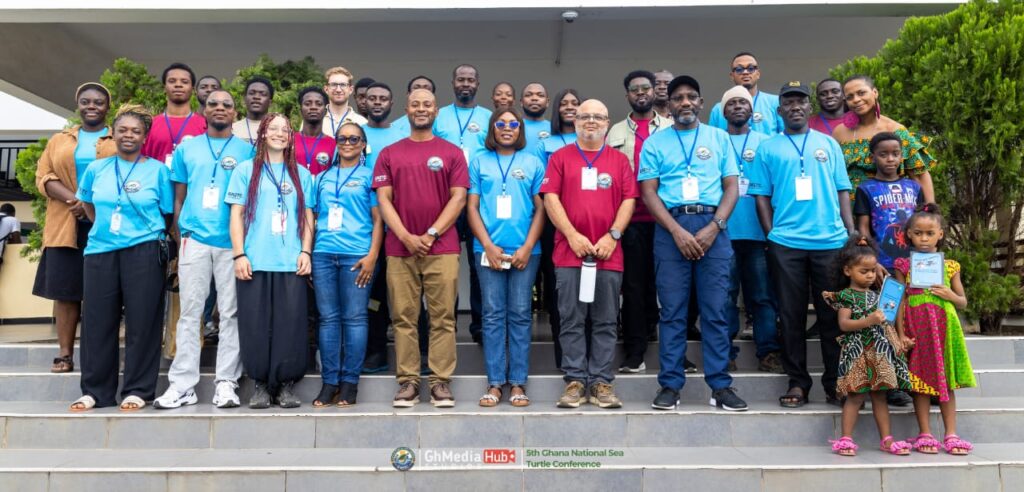
Stakeholders working to protect sea turtles in Ghana have been urged to treat coastal communities as active partners in conservation efforts rather than merely beneficiaries of environmental programmes.
Executive Director of the Wildlife and Human Resources Organisation (WHRO) Ghana, Dr Andrews Agyekumhene, said meaningful community participation was critical to achieving sustainable and lasting results in marine conservation.
Speaking at the 5th Ghana National Sea Turtle Conference (GNSTC 2026) in Accra on Friday, September 4, he called for coastal residents to be fully involved in conservation planning, decision-making and monitoring.
“Community stewardship means moving beyond conservation for communities to conservation with communities. It means recognising coastal communities not simply as beneficiaries or people who need to be educated, but as partners, custodians and active participants in conservation,” he said.
Dr Agyekumhene, who is also a Senior Lecturer at the University of Ghana’s Department of Marine and Fisheries Sciences, said the survival of sea turtles was closely linked to activities within coastal communities.
He explained that coastal communities were located around areas where sea turtles nested, fishing activities took place and coastal developments were undertaken, making residents important actors in efforts to protect the species.
While scientific research, monitoring, legislation and enforcement remained essential, he said conservation efforts would be more sustainable if local communities understood the value of sea turtles and benefited directly from initiatives designed to protect them.
“Empowering communities to participate in monitoring and decision-making can help sustain conservation efforts beyond the lifespan of individual projects and their funding arrangements,” he said.
Emerging threats
Dr Agyekumhene identified coastal development, light pollution, human activities and climate change among the major threats to sea turtle conservation in Ghana.
He consequently called for stronger collaboration among researchers, conservation practitioners and coastal communities to address the challenges.
“We need stronger collaboration between science and practice. We need better integration of local knowledge and scientific knowledge. We need to strengthen community involvement. We need to invest in young people. We need to make better use of volunteers. And we need to build partnerships that can sustain conservation beyond the lifespan of individual projects,” he said.
He encouraged participants to use the conference to develop innovative approaches and strengthen partnerships aimed at protecting sea turtles and their habitats in Ghana.
Sea turtle conference
The Ghana National Sea Turtle Conference was established in 2018 as a platform for researchers, conservation organisations, government institutions, coastal communities, students and volunteers to exchange knowledge and develop solutions to challenges affecting sea turtle conservation.
The 2026 conference was held under the theme, “Sea Turtle Conservation in Ghana: Strengthening Community Stewardship for Lasting Impact.”
It was organised by WHRO Ghana in collaboration with the University of Ghana’s Department of Marine and Fisheries Sciences.
The conference brought together researchers, conservation practitioners, government representatives, community members, students and young professionals to discuss strategies for ensuring the long-term protection of sea turtles and their habitats.
DISCLAIMER: The Views, Comments, Opinions, Contributions and Statements made by Readers and Contributors on this platform do not necessarily represent the views or policy of Multimedia Group Limited.
DISCLAIMER: The Views, Comments, Opinions, Contributions and Statements made by Readers and Contributors on this platform do not necessarily represent the views or policy of Multimedia Group Limited.
Source link


