


A seedling that looks strong and well developed may not necessarily be the best one to put in the ground.
That was one of the lessons Dr Eva Agana took away from a recent gathering of restoration practitioners in Sunyani in the Bono East Region of Ghana.
At Talmond Limited, where she is Sustainability Manager, seedlings were sometimes allowed to grow bigger in the nursery before being transplanted.
The thinking was that a larger, and more developed seedling would have a better chance of surviving in the field. But Dr Agana says she has now learned that the opposite can be true.
“Allowing them to grow too large in the nursery can actually reduce their ability to adapt to the wind and other conditions in the natural environment.”
Dr Agana has been part of the programme from the beginning. She says the second peer-to-peer learning exchange brought together cohort winners of the TerraFund and AFR100 programmes to share their experiences and learn from one another.
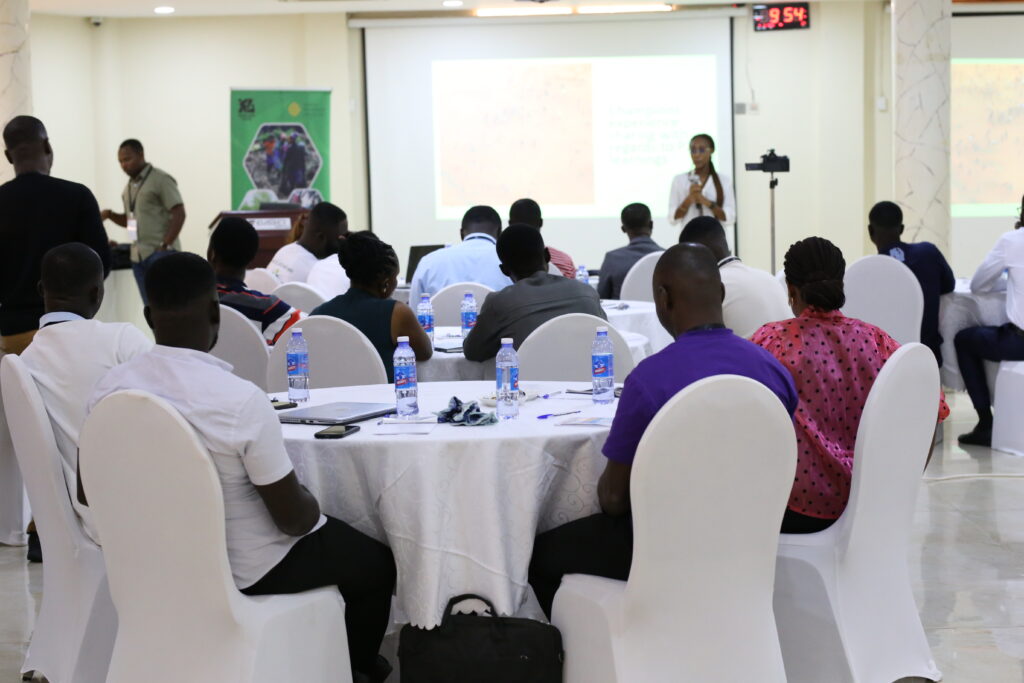
For her, the value was in discovering practices that her organisation had not been using.
“The key element for me… has been learning what other organisations have been doing that we were not doing,” she says.
She says the exchange also exposed her to technologies and approaches that could now be applied in her organisation’s day-to-day restoration work and reporting. One of the lessons was how to prepare seedlings for transplanting.
Dr Agana says seedlings need to be prepared properly after being nursed so that they can develop the strength and structure to cope with conditions outside the nursery.
“The younger they are, the stronger they become with time,” she says, adding that, “when you allow them to grow bigger in the nursery before transplanting, their survival rate becomes lower.”
What happens after a tree is planted
For Akosua Pokuaa Yeboah, a Field Assistant at Tropenbos Ghana in Kumasi, the lessons began with the planting itself.
“You don’t just go to your landscape and start planting. You have to know when to plant, which is most important,” she says.
Where the tree is planted also matters. Miss Yeboah says the terrain of a landscape has to be considered before planting. In a low-lying valley, for instance, seedlings may be exposed to flooding if they are planted directly into the ground.
“You have to make a small mound and then plant on it to prevent flooding and the loss of seedlings,” she says.
But planting is only the beginning. She says seedlings have to be monitored because some may fail to survive after being moved from the nursery to the field.
“It may be that they did well in the nursery soil. But when you move them to the planting site, they can experience transplanting shock,” she says.
When a seedling dies, the cause needs to be established before it is replaced.
“Whether it was a pest infestation or simply transplanting shock, you need to understand why the seedlings did not thrive,” she says.
The replacement of dead seedlings is known as “beating up”. Miss Yeboah says understanding why seedlings died helps practitioners know how to respond rather than simply replacing them without addressing the underlying problem.
The exchange has also given her lessons she intends to use immediately. “We are at the planting stage of this project, and I am going to apply what I have learned here to my planting projects,” she says.
Restoration and livelihoods
For Okyere-Boateng Yaw Junior of Obaatanpa Nyame Nti Ltd, the learning exchange showed that restoration is also closely linked to the livelihoods of communities living around forest reserves.
His organisation works in plantation establishment and agroforestry. He says the training helped participants understand how plantation establishment can provide income for communities while supporting restoration.
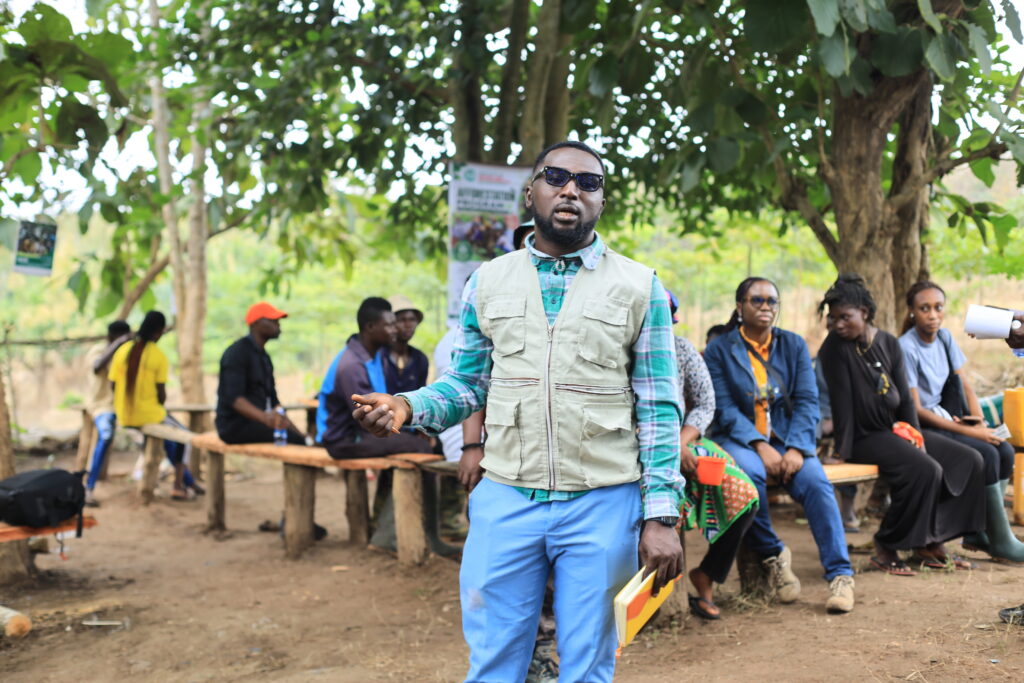
“It has helped us understand how to improve livelihoods through plantation establishment and create sources of income for communities around the reserve,” he says.
The exchange also gave participants practical lessons on survival-rate assessments and beating up.
Yaw Junior says one of the organisations, Institute of Nature and Conservation (INEC) took participants to a plantation site where they learned how to carry out beating up and establish sample plots for assessing survival rates.
He says the exercise also strengthened their understanding of stakeholder engagement and the role of plantation establishment in supporting forest communities.
Who will pay for restoration?
While participants were learning how to improve what happens on the ground, the exchange also raised a question of how restoration work can continue when traditional sources of funding become harder to secure?
Landscape Restoration Manager for the World Resources Institute’s Ghana Cocoa Belts programme, Eric Lartey, says philanthropic funding has supported much of the restoration work so far.
But he says it cannot be the only source of money. “Restoration has largely been delivered through philanthropic grants or philanthropic funding. But it has become obvious that, at this stage, we cannot rely on that alone,” he says.
For Mr Lartey, private-sector investment will have to play a bigger role. “Restoration cannot be sustainable without private-sector participation because one of the biggest gaps we need to fill in restoration is financing,” he says.
He says WRI is therefore looking at ways of using grants to attract additional private-sector investment into restoration.
“WRI’s new approach is not to continue with traditional grants or philanthropic financing, but to use grants to catalyse additional private-sector inflows,” he says.
One of the approaches being introduced is outcome-based finance. Mr Lartey says the concept is relatively new in restoration, although it is used in sectors such as health and education.
The peer-to-peer exchange provided an opportunity to introduce restoration champions to the approach.
“The kind of questions asked by the restoration champions demonstrated that they had gained some knowledge and understanding of the concept,” he says.
But funding is not the only issue. Mr Lartey says restoration must also be carried out in the right places and to a high standard, while local institutions need to be part of the process.
“Local leadership does not just mean that communities must be at the forefront; it also means considering the roles of local institutions,” he says.
That includes traditional structures, community structures and local government institutions.
He says bringing organisations with different levels of experience together allows knowledge to move between them.
“Those who are more experienced and knowledgeable in the space can transfer their knowledge and experience to the relatively newer cohorts within the restoration space,” he says.
That exchange is already influencing how some participants intend to work. For Dr Agana, the most useful lessons were the ones she could take back to Talmond and apply.
“It has been interesting to learn from other people and understand what they are doing differently at their restoration sites, so that we can also adopt some of those practices within our own work,” she says.
The lessons may sound small, how large a seedling should be before transplanting, where to plant it, how to respond when it dies and how to record the replacement.
But for the people carrying out restoration work, those details can determine what happens after the planting is over.
And beyond the field, there is another question they will have to answer and that is how to find the money to keep the work going.
DISCLAIMER: The Views, Comments, Opinions, Contributions and Statements made by Readers and Contributors on this platform do not necessarily represent the views or policy of Multimedia Group Limited.
DISCLAIMER: The Views, Comments, Opinions, Contributions and Statements made by Readers and Contributors on this platform do not necessarily represent the views or policy of Multimedia Group Limited.
Source link
