


Ghana marks National Youth Week against a demographic and labour-market reality that should concentrate the minds of policymakers, educators and anyone concerned about the country’s future.
About 38% of Ghana’s population is between 15 and 35 years. Yet the Ghana Statistical Service reports that youth unemployment averaged 21.9% during the first three quarters of 2025, compared with 12.8% nationally. Nearly two million young people, representing about 19.5% of the youth population, were not in employment, education or training. Greater Accra recorded youth unemployment of 31.9%, while Ashanti recorded 27.2%.
These figures should not merely produce another conversation about job creation. They should force us to examine how economic value itself is increasingly being created.
This is where technological convergence and disruptive innovation become important.
Understanding convergence and disruption
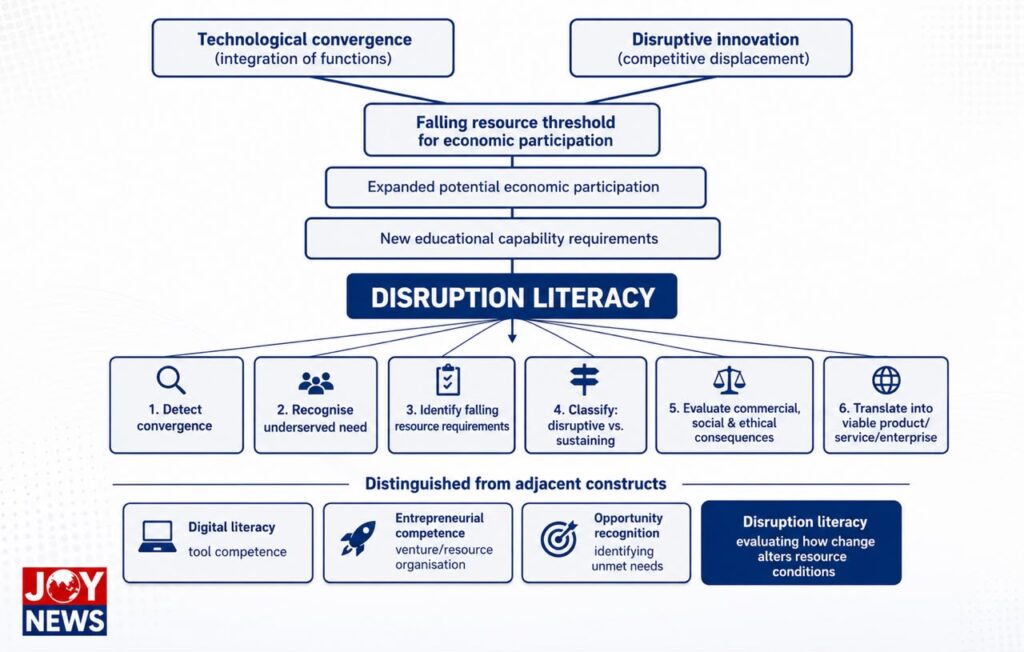
Technological convergence refers to the increasingly blurred boundaries between technologies and functions that were previously separate. A smartphone, for example, can simultaneously function as a camera, writing and editing tool, recording studio, design workstation, communication device, marketing channel, distribution platform, payment interface and gateway to artificial intelligence.
Artificial intelligence is accelerating this convergence.
A young person can now write a book, record a podcast, shoot a documentary, design promotional material, establish an online shop, market a service or communicate with customers using a relatively small collection of digital tools.
But technological convergence should not automatically be confused with disruptive innovation.
Disruptive innovation, in the more specific sense developed by Clayton Christensen and colleagues, concerns innovations that initially serve overlooked or underserved markets through more accessible offerings and can subsequently alter established market structures. Not every new technology is therefore disruptive.
The distinction matters because the more important policy question is not simply whether a technology is disruptive, but what it changes about who can participate, what resources they require and how value is created and distributed.
That question is particularly relevant to Ghanaian youth.
The changing economics of participation
Historically, entering many industries required substantial capital.
Publishing required access to presses, editorial expertise, distribution networks and retail channels. Film required cameras, production equipment and studios. Music required recording infrastructure and distribution arrangements. Retail required physical premises and inventory. Financial services required branches and institutional infrastructure.
Technological convergence is changing some of these entry conditions.
An aspiring author can now write, edit, design and distribute a book digitally. A young filmmaker can shoot and edit a documentary using a smartphone. A podcaster can record and distribute programmes without establishing a conventional studio. A musician can produce and distribute music through digital platforms. A designer can reach clients beyond Ghana without establishing a physical agency. An entrepreneur can establish an e-commerce operation, market through social media and receive digital payments without immediately renting a shop.
This does not mean that success has become easy.
Technology can reduce the barrier to entry without eliminating the barriers to success.
A person can publish a book and still struggle to find readers. A filmmaker can produce a documentary and struggle for distribution. An entrepreneur can establish an online store and struggle to acquire customers. A creator can produce excellent content and remain invisible because algorithms determine what audiences see.
In other words, technology may remove one gatekeeper while creating another.
The traditional publisher, record label, broadcaster or retailer may no longer be the sole intermediary. Platforms, algorithms, search engines and social-media systems can increasingly determine visibility and access to audiences.
This is why technological convergence should be treated as a policy question rather than simply a technological one.
Africa is already demonstrating what is possible
Mobile money provides perhaps the clearest African illustration of technological convergence.
In 2024, the global mobile-money industry surpassed two billion registered accounts, with more than half a billion monthly active accounts. More than one billion registered accounts were in Sub-Saharan Africa.
Mobile money did not simply digitise an existing banking process. It helped extend financial services through infrastructure that people already possessed: mobile phones.
The lesson is important. Technological innovation can sometimes enable populations to leapfrog parts of conventional infrastructure.
The same principle is emerging across creative industries, commerce, education and professional services.
For Ghana, this creates an opportunity.
But opportunity is not the same as capacity.
The financing problem cannot be ignored
There is a temptation to argue that technology has solved the capital problem because young people can now start businesses with a phone.
That would be misleading.
The World Bank estimated Ghana’s MSME financing gap at approximately US$6.1 billion, equivalent to 13% of GDP, and found that about 74% of MSMEs were partially or fully credit-constrained.
Technological convergence can reduce the amount of capital required to enter some markets, but it cannot substitute for an effective financial ecosystem.
This distinction is crucial.
A young person may no longer need a recording studio to produce music, a printing press to publish a book or a physical shop to begin selling online. But they still need connectivity, skills, working capital, intellectual-property protection, payment systems, customers and an environment in which an enterprise can survive.
Technology can lower the threshold of participation. It cannot eliminate structural constraints.
That is precisely why education becomes important.
From digital literacy to opportunity literacy
Our educational conversation about artificial intelligence and emerging technologies is often reduced to a simple question: Should students learn AI?
I believe the more important question is:
What should education prepare young people to do when technology is changing the resources, skills and processes required to create economic value?
Knowing how to use an AI tool is not enough.
A young person should also be able to identify a problem, recognise an underserved market, determine whether technology can reduce the cost of solving it, develop a product or service, test it, market it, protect its intellectual property and build a sustainable enterprise.
That requires what I would describe as technological opportunity literacy.
Students should learn to ask:
What has become possible?
What previously required substantial resources can now be done differently?
Which markets are underserved?
What new skills are becoming valuable?
What new businesses can emerge from technological convergence?
And perhaps most importantly:
How can I create value rather than merely consume technology?
Capacity building must have four dimensions
This is why simply distributing devices or providing short AI courses should not be mistaken for comprehensive capacity building.
At minimum, Ghana’s youth require four complementary capacities.
First, technological capacity: the ability to use digital and AI technologies effectively.
Second, entrepreneurial capacity: the ability to identify opportunities and turn technological capabilities into viable products, services and enterprises.
Third, critical capacity: the ability to evaluate AI-generated information, misinformation, bias, quality, authenticity and ethical implications.
Fourth, institutional capacity: access to finance, markets, intellectual-property protection, reliable connectivity, digital payments, mentorship and supportive regulation.
If we develop only the first, we risk producing technologically competent consumers rather than technologically enabled creators and innovators.
Reform must begin before university
This capacity-building agenda cannot be postponed until tertiary education.
Ghana’s own youth data point towards the need for a broader rethink. The Ministry of Youth Development and Empowerment reports that the proportion of young people attaining secondary education increased from 23% in 2015 to 37.4% in 2024, while bachelor’s-degree attainment increased from 5.2% to 9.1%. Yet technical and vocational education declined from 2.5% to 1% over the same period. The Ministry has also highlighted the imbalance between humanities and social sciences and STEM participation.
The response should not be to declare one field superior to another. Rather, every discipline should develop the capacity to engage technological change.
At the basic-school level, children should encounter problem-solving, creativity, digital literacy and opportunity recognition alongside foundational education.
At the secondary and TVET levels, students should increasingly learn through practical production, entrepreneurship, technology and work-based learning.
At the university level, students should be encouraged to move beyond consuming established bodies of knowledge towards experimentation, commercialisation, intellectual-property development and interdisciplinary problem-solving.
A publishing student should understand self-publishing and digital distribution. A communication student should understand podcasting and creator media. A film student should understand mobile production and digital distribution. A business student should understand e-commerce and platform economies. An agriculture student should understand digital markets and technology-enabled production.
The principle is simple: Education should prepare students not only to enter existing value chains, but to recognise when those value chains are changing.
From job seekers to opportunity creators
Ghana’s youth policy conversation has understandably focused on employment. But employment and entrepreneurship should not be treated as entirely separate questions.
If technological convergence is lowering the cost of participating in certain markets, then youth policy should deliberately equip young people to exploit those opportunities.
This does not mean telling every graduate to become an entrepreneur. It means ensuring that a young person who identifies an opportunity has the knowledge and capabilities to pursue it.
Our young people should be able to ask not only:
Who will employ me?
but also:
What problem can I solve?
What can I create with the resources available to me?
How can technology reduce the cost of solving it?
Who needs this solution?
How can I turn it into sustainable value?
That is the mindset Ghana needs to cultivate.
The International Labour Organization estimates youth NEET at 21.8% in Sub-Saharan Africa, demonstrating that Ghana’s challenge exists within a much wider continental employment and skills problem.
We therefore need to move beyond the idea that the solution lies exclusively in creating more conventional jobs.
We need an education system that can help young people create, adapt and participate in new forms of economic activity.
A policy opportunity
Government, Parliament, educational institutions and development partners should therefore consider four priorities.
First, embed technological, entrepreneurial, critical and institutional capacities across the education system, rather than treating digital skills and entrepreneurship as isolated electives.
Second, strengthen TVET, apprenticeships and practical learning, while making them more responsive to technological and industry changes. This is particularly important given the decline in TVET participation identified by the Ministry of Youth.
Third, connect education reform to enterprise finance and market access. The financing gap cannot be solved by technology alone.
Fourth, use platforms such as National Youth Week not merely to celebrate young people but to examine whether Ghana is giving them the capabilities and institutional conditions required to participate in the economy that is emerging.
Ghana’s youth bulge can become either a demographic dividend or a development challenge. Technology does not determine which outcome we get.
Policy does. Education does. Capacity does.
The question before us is therefore bigger than whether Ghanaian students should learn artificial intelligence.
It is whether we will prepare them merely to use the technologies of the future, or to recognise the opportunities those technologies create.
Technological convergence is already changing how people produce, distribute and commercialise value. Disruptive innovation is changing who can enter markets and challenge established arrangements.
Our education system must respond accordingly.
We should move from digital literacy to technological opportunity literacy; from technology consumption to value creation; and from preparing young people only for the jobs that exist to preparing them to participate in, and help shape, the economy that is emerging.
That is not simply an education reform agenda. It is a national development imperative.
DISCLAIMER: The Views, Comments, Opinions, Contributions and Statements made by Readers and Contributors on this platform do not necessarily represent the views or policy of Multimedia Group Limited.
DISCLAIMER: The Views, Comments, Opinions, Contributions and Statements made by Readers and Contributors on this platform do not necessarily represent the views or policy of Multimedia Group Limited.
Source link
