


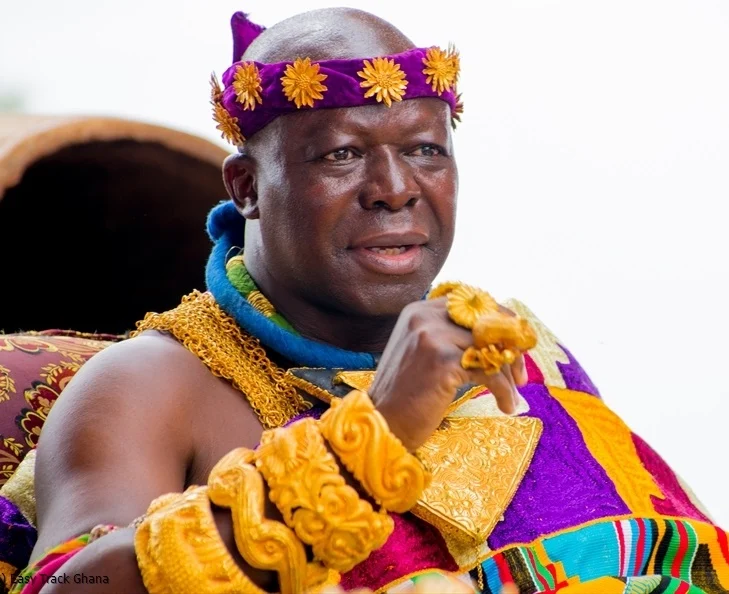
The Asantehene, Otumfuo Osei Tutu II, has urged Ghana to place greater emphasis on developing its creative industry, identifying the sector as a major source of employment, wealth creation and long-term economic growth.
He believes Ghana stands to gain significantly by investing in its arts, fashion and cultural industries, particularly through improved technical education, local manufacturing and stronger financial support for creative businesses.
The Asantehene reportedly made the remarks during the Faculty of Applied Arts and Technology (FAAT) Week celebration at Takoradi Technical University (TTU), where he challenged the institution to equip students with the practical knowledge and professional skills required to strengthen the country’s creative economy.
– Advertisement –
He cited the fashion industry as an example of the economic opportunities Ghana could harness, revealing that the sector contributes an estimated GH¢2 billion to the national economy. However, he maintained that its contribution could increase considerably if local designers and manufacturers received the support needed to expand their operations.
Otumfuo expressed concern that Ghana’s creative talents were gaining international recognition without a corresponding increase in the availability of locally manufactured products on the domestic market. Imported fashion items, he noted, continue to occupy a significant portion of retail spaces, leaving Made-in-Ghana products with limited visibility.
“What you cannot find in the shops, though, are Made-in-Ghana labels and sadly, even on the domestic market, our shops are dominated by foreign products, save for the growing indigenous sector,” he observed.
The situation, in his view, points to a gap between the growing reputation of Ghanaian creative professionals and the country’s ability to convert their talents into commercially successful local industries.
He therefore encouraged artists, fashion designers and students to focus on producing high-quality work, adopt innovative approaches and position their creations to meet international standards without abandoning the cultural influences that define Ghanaian identity.
READ ALSO: Shatta Wale Advises Ghanaian Youth Against Keeping Friends Who Introduce Them To Drugs
Beyond the challenges facing the creative sector, the Asantehene highlighted the shortage of middle-level technical professionals as another constraint on Ghana’s industrial development.
He called on Takoradi Technical University to take a leading role in addressing the skills deficit by bringing traditional knowledge into formal education, creating stronger links between experienced artisans and young designers, and combining indigenous craftsmanship with modern production technologies.
“Your university stands at the critical point in the value chain where heritage and culture meet economic value,” he said.
Ghana’s established traditions in weaving, pottery, metalworking, woodcarving, architecture and visual communication, he explained, offer considerable opportunities for building a creative industry with international reach.
He argued that combining these cultural practices with contemporary design methods and advanced production techniques would enable local artisans and designers to develop competitive products for both domestic and overseas markets.
As part of activities marking the FAAT Week celebration, the Asantehene also cut the sod for the proposed Otumfuo Osei Tutu II Art Museum at Takoradi Technical University.
The planned museum is expected to serve as a centre for artistic expression and cultural preservation while providing additional opportunities to promote Ghana’s creative arts and showcase the country’s heritage.
The event was held under the theme, “Celebrating Heritage, Innovation, and Excellence: A Tribute to Otumfuo Osei Tutu II’s Legacy.”
It featured cultural performances, an exhibition of artistic works and a fashion show displaying designs produced by students of the Faculty of Applied Arts and Technology.
Otumfuo commended the university for giving arts and cultural heritage an important place in its academic programmes. He urged the institution to build on that foundation by developing the technical expertise, creativity and professional competence required to turn Ghana’s cultural assets into sustainable economic opportunities.
– Advertisement –


