



Special Prosecutor Kissi Agyebeng says the work of the Office of the Special Prosecutor (OSP) has made corruption increasingly costly for individuals in both the public and private sectors, creating a deterrent effect against corrupt practices.
According to Mr Agyebeng, people are now more cautious about engaging in corruption because of the likelihood of investigations and the consequences that may follow.
“No person, whether in the public or private space, now engages in corruption lightly. This is because such acts have become costly as a result of the operations of the OSP,” he said.
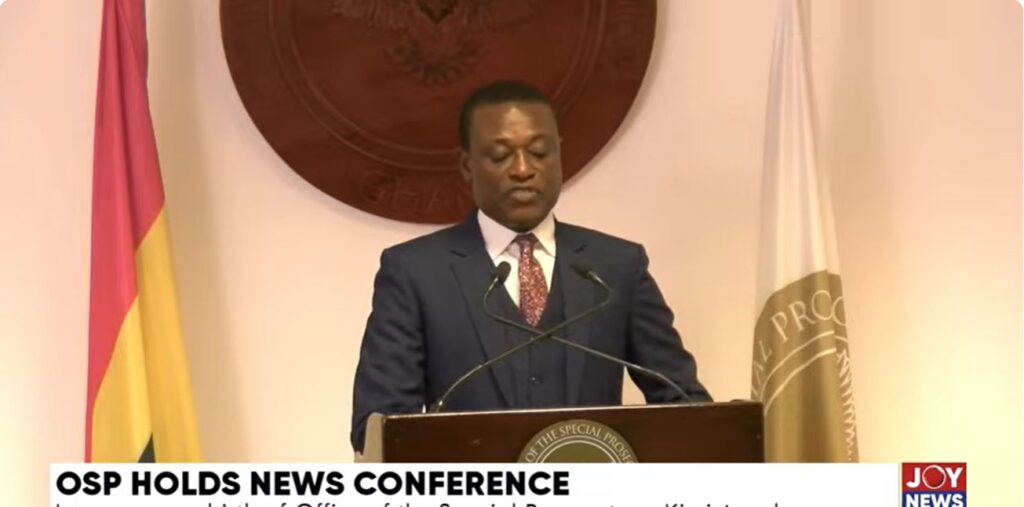
Mr Agyebeng made the remarks at a press briefing on Wednesday, August 26, 2026, where he outlined what he described as the measurable and verifiable outcomes of the OSP’s work.
OSP cites financial recoveries, savings
The Special Prosecutor said the deterrent effect of the OSP’s work should be assessed alongside prosecutions, convictions and financial recoveries when evaluating the institution’s performance.
He cited financial recoveries of GH¢8.5 million and US$2 million, as well as movable and immovable assets linked to ongoing recovery proceedings.
He also highlighted the OSP’s intervention at the Tema Oil Refinery (TOR), which he said helped prevent the state-owned refinery from being “pawned off” and contributed to its return to operation after years of inactivity.
According to Mr Agyebeng, the OSP’s work in the customs sector has also resulted in a more robust auction system and a significant reduction in the abuse of the Customs Advanced Ruling regime.
He said the interventions had helped the state recoup additional revenue.
The Special Prosecutor further disclosed that the OSP’s intervention in the government payroll system had saved the country a little over GH¢100 million so far.
OSP says value generated exceeds resources allocated
Mr Agyebeng further claimed that the total financial value generated or protected through the OSP’s interventions exceeds 20 times the resources allocated to the institution since its establishment.
He argued that the figure demonstrates that the institution has not only justified the resources invested in it but has also generated significant value for the state.
“These are measurable outcomes. These are verifiable outcomes,” he stressed.
Mr Agyebeng acknowledged that criticism of the OSP was legitimate and said the institution must remain open to scrutiny.
He, however, cautioned against dismissing the office’s work without reference to evidence.
“Criticism is legitimate. Scrutiny is necessary. However, it must be based on facts and not on baseless dismissiveness,” he said.
He maintained that the OSP’s performance should be assessed objectively, rather than through political applause, social media commentary or the views of individuals who may have been affected by its investigations.
His comments come amid renewed debate over the effectiveness and future of the OSP, with critics questioning its achievements and calling for changes to the institution.
Mr Agyebeng, however, maintained that the OSP’s record demonstrates a tangible impact on the fight against corruption and efforts to protect public resources.
DISCLAIMER: The Views, Comments, Opinions, Contributions and Statements made by Readers and Contributors on this platform do not necessarily represent the views or policy of Multimedia Group Limited.
DISCLAIMER: The Views, Comments, Opinions, Contributions and Statements made by Readers and Contributors on this platform do not necessarily represent the views or policy of Multimedia Group Limited.
Source link
