


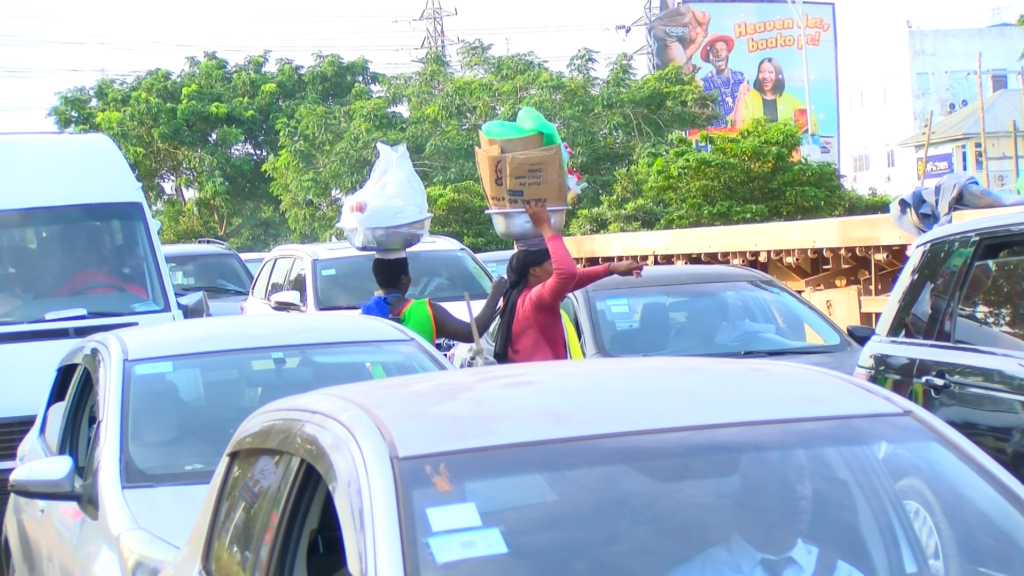
For people who spend long hours beside busy roads, breathing polluted air is often part of the job.
Street vendors, traffic officers, market traders, construction workers and other outdoor workers can spend hours each day exposed to exhaust fumes and other pollutants.
Now, a new Ghanaian study suggests that what they eat could help their bodies cope with some of the damage caused by polluted air.
The Dietary Intervention to Mitigate Air Pollution health effects among street hawkers and vendors in Accra (DIMAP) study, conducted by researchers from the University of Cape Coast, followed 307 street vendors in Accra for 12 months.
The study was led by Professor Kofi Amegah, an Associate Professor of Environmental and Nutritional Epidemiology at the University of Cape Coast.
One group of vendors received a weekly supply of foods including oranges, peanuts, sunflower oil, eggs and sardines, while another group continued with their usual diets.
The vendors worked along some of Accra’s busiest roads, including Atomic Junction, Madina, Lapaz, Tetteh Quarshie, Kaneshie, Graphic Road, Makola and Kwame Nkrumah Circle.
These are areas where thousands of vehicles pass every day, exposing people who work there to pollution for long periods.
Prof. Amegah says this prolonged exposure is what prompted the research.
“And then they are exposed to a high level of a dangerous cocktail of pollutants for very long hours. So it’s important that we protect their health. And that is the main reason why we conducted this experimental study to look at the effectiveness of nutrition intervention for mitigating or attenuating the health effects among the street vendors.”
Air quality monitors used during the study recorded average PM2.5 levels of about 40 micrograms per cubic metre along the study routes.
PM2.5 is made up of extremely small particles in the air. They are so tiny that they can travel deep into the lungs and, in some cases, enter the bloodstream.
Long-term exposure can increase the risk of heart and lung diseases, stroke and other serious health problems.
The World Health Organization recommends that the 24-hour average level of PM2.5 should not exceed 15 micrograms per cubic metre.
After following the vendors for a year, researchers found that those who regularly ate the antioxidant-rich foods reported fewer symptoms associated with air pollution.
They were 55 percent less likely to develop a persistent cough, 60 percent less likely to experience difficulty breathing, and 81 percent less likely to suffer dizziness.
The biggest difference was recorded in irregular heartbeat. Vendors who received the food intervention were 92 percent less likely to experience the condition. They were also 66 percent less likely to be admitted to hospital for the symptoms studied.
Prof. Amegah, however, says the evidence should be viewed carefully.
“The evidence is…supported by the biology. And the biology is that antioxidants are able to mop up free radicals, which are the pollutants.”
Antioxidants are substances found naturally in many foods. They help the body deal with harmful substances that can be produced when pollution enters the body.
The researchers therefore recommend increasing the intake of foods such as oranges and other fruits, vegetables, nuts, eggs, peanuts and foods rich in omega-3 fatty acids, including fatty fish and avocado.
Prof. Amegah says, “So we are advocating, or we are advising them to increase intake of antioxidant-rich foods like oranges, like all the fruits, vegetables, nuts, cooking oils, eggs, peanuts, etc., which are very rich in antioxidants like vitamin C, like vitamin E and selenium.”
He also cautions that changing diets cannot replace efforts to clean up Ghana’s air.
“So what we need to understand is that this is not a substitute for air quality regulations. So we need to have air quality regulations that will help to curb the air pollution problem in our area.”
The findings come as Ghana continues to deal with air pollution from several sources, including vehicle emissions, open burning, household fuels and industrial activities.
For people who work outdoors, avoiding exposure can be difficult because their income depends on being on the streets.
Prof. Amegah says the solution must therefore combine personal protection with stronger action from government and local authorities.
“So every street vendor across Ghana needs to protect themselves by, one, mitigating or minimizing their exposure by wearing nose masks, etc. And then also eating well, eating a balanced diet, and importantly, eating antioxidant-rich food.”
But he says the greater responsibility lies in reducing pollution at its source.
“Oh, the call on government is what we are saying, that they need to invest in air pollution control. They need to support the municipal, metropolitan and district assemblies. So that at least we can be able to address the air pollution problem, which is worsening in our space on a daily basis.”
The researchers stress that the study does not mean people should simply eat oranges or sardines and continue breathing polluted air.
Instead, they say better nutrition could be one part of a wider response while Ghana works to reduce the pollution that people are exposed to every day.
For the thousands of people whose workplaces are Accra’s busy roads and markets, that wider response cannot come soon enough.
This story was a collaboration with New Narratives. Funding was provided by the Clean Air Fund, which had no say in the story’s content.

DISCLAIMER: The Views, Comments, Opinions, Contributions and Statements made by Readers and Contributors on this platform do not necessarily represent the views or policy of Multimedia Group Limited.
DISCLAIMER: The Views, Comments, Opinions, Contributions and Statements made by Readers and Contributors on this platform do not necessarily represent the views or policy of Multimedia Group Limited.
Source link


