


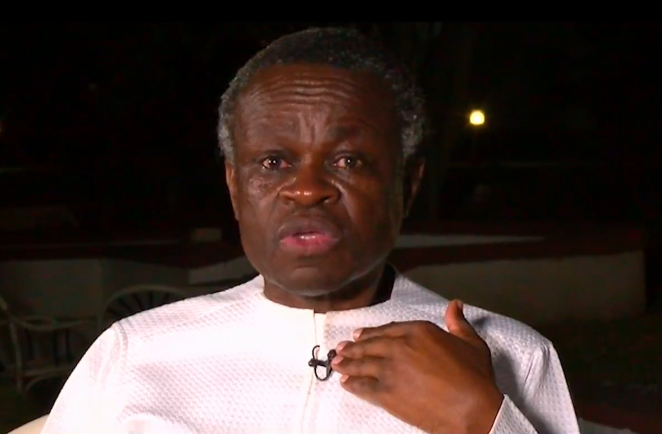

Renowned Pan-Africanist and Kenyan lawyer Prof Patrick Lumumba has described Ghana’s first President, Dr Kwame Nkrumah, as a “lonely man”, saying his commitment to the broader African cause left him vulnerable to opposition both within Ghana and from forces outside the country.
Speaking on Joy Prime on September 22, Prof. Lumumba said Nkrumah’s vision extended beyond Ghana’s immediate national interests, setting him apart from others who had participated in the independence struggle.
He explained that while some members of the independence movement were focused primarily on Ghana, Nkrumah was thinking about the political and economic future of the entire African continent.
“My own interpretation is that while others were very proficient in their thoughts, there are those within Ghana who, when they had been part of the independence movement, only thought about Ghana. But Nkrumah thought about Africa and in that regard, there were those who thought, but why are we using the resources of Ghana for other countries? And that made him very vulnerable,” he said.
According to Prof. Lumumba, the difficulty was compounded by the gap between Nkrumah’s long-term vision and the immediate needs and expectations of Ghanaians.
He said a population dealing with pressing economic and social challenges could become impatient when asked to support projects and ideas whose benefits might only become apparent decades later.
“When you are dealing with a population that once bred on the table now, and you are talking to them about things that will be realised in 50 years, then you can imagine how impatient they are,” he said.
Prof. Lumumba said Nkrumah’s political opponents could exploit that impatience by presenting his Pan-African commitments as evidence that he was neglecting Ghana’s interests.
“Then you can imagine how your detractors and your enemies will then come and say, this gentleman is not talking about us. He’s thinking about things and using our resources in a manner that is not in our best interest,” he said.
“And you then become a sitting duck. And that, I think, is part of the reason why it was very easy to have 50 colonists.”
Prof. Lumumba also argued that Nkrumah faced opposition beyond Ghana because of his outspoken position against colonialism and what he described as neocolonialism.
He said Nkrumah was regarded as a threat by those seeking to retain influence over newly independent African states.
“And remember that Osagyefo was also being seen by the neocolonialists as a danger,” he said.
Prof. Lumumba said Nkrumah sought to encourage Africans to critically examine the interests of former colonial powers and other Western countries operating on the continent.
“This was an African who was removing the scales from the eyes of fellow Africans to make them see clearly that the British are not your friends. The Americans are not your friends. They want something from you,” he said.
He added that Nkrumah believed foreign powers could present themselves as allies while pursuing their own interests.
“They may pretend to be your friends. They may smile with you, but they are going to stab you in the back. They are doing everything in their power to ensure that this individual must be taken out.”
Prof. Lumumba further pointed to Nkrumah’s engagement with other African leaders and liberation figures as part of his wider campaign for African unity.
“This is an individual who wants people to unite against neocolonialism. He’s talking to Lumumba in Congo. He’s talking to Modibo.
“He’s talking to the Secretary in Guinea. He’s talking to everybody. He’s talking to Mugabe.
“This is a man who must be taken out. So, combine that tunnel, mix it with the internal. Nkrumah was a lonely man.”
DISCLAIMER: The Views, Comments, Opinions, Contributions and Statements made by Readers and Contributors on this platform do not necessarily represent the views or policy of Multimedia Group Limited.
DISCLAIMER: The Views, Comments, Opinions, Contributions and Statements made by Readers and Contributors on this platform do not necessarily represent the views or policy of Multimedia Group Limited.


