


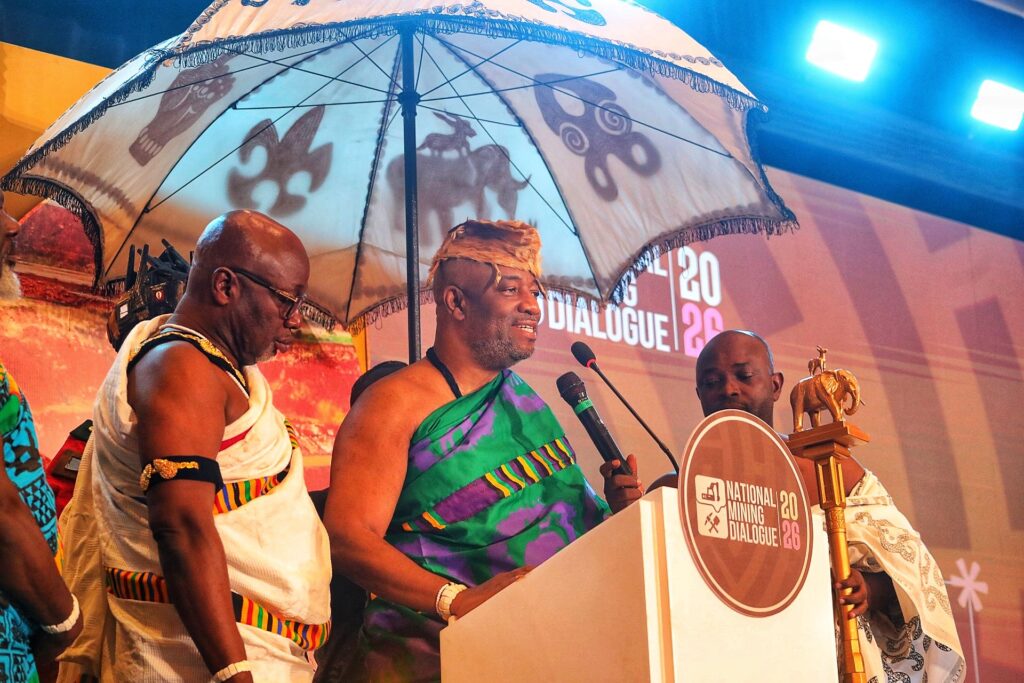
The Ga Mantse, King Tackie Teiko Tsuru II, has called for a stronger sense of responsibility in the management of Ghana’s mineral resources, warning that mining must be viewed as more than a commercial activity because it involves lands held in trust for present and future generations.
Speaking at the National Mining Dialogue event organised by Asempa FM’s and its flagship programme, Ekosiisen, in partnership with Semmis DS and the Ministry of Lands and Natural Resources at the Kempinski Hotel in Accra on Tuesday, August 18, the Ga Traditional Council leader said traditional authorities had historically regarded stools and skins as custodians of land on behalf of generations yet unborn.
He said the granting of mining concessions therefore carried implications that extended well beyond the immediate financial returns of mineral extraction.
“For generations, our stools and skins have held lands in trust, for those who have left us and those living today, as well as those who will come after us,” King Tackie Teiko Tsuru II said.
The Ga Mantse stressed that the custodianship of land was temporary, placing a duty on the present generation to ensure that natural resources were not exploited in ways that compromised the ability of future generations to benefit from the same inheritance.
“The reality is that we are temporal custodians of something that will outlive us,” he said.
King Tackie Teiko Tsuru II said the decision to grant a mining concession should not be treated simply as a transaction between a landowner, the state and a mining company.
He argued that every concession represented the transfer of access to a resource that had been preserved across generations and would have consequences for communities long after mining operations had ended.
“When a concession is granted, when a pit is dug, when a river is diverted, we are dealing with something that is far greater than a commercial transaction,” he said.
According to him, mining companies and other beneficiaries of Ghana’s mineral resources must recognise that the permission to exploit the country’s resources comes with corresponding obligations to communities, the environment and future generations.
“We are placing a generational inheritance into the hands of those who have been permitted to mine these lands or to benefit from it. And with that permission must come responsibility,” the Ga Mantse said.
While highlighting the responsibilities associated with mining, the Ga Mantse also acknowledged the potential of a properly managed mining industry to contribute significantly to national and community development.
He said responsible mining could provide infrastructure and social services that would improve the quality of life in mining communities.
“Properly managed mining can build roads, build hospitals, build schools, build health centres, and provide clean drinking water,” he said.
He further identified education and skills development as important areas where mining revenues and corporate investments could make a lasting difference.
According to him, mining could support schools, fund scholarships and provide vocational training, helping young people acquire skills that would improve their prospects for employment and entrepreneurship.
He said the sector could therefore play a meaningful role in creating opportunities for young people and enabling them to contribute to the development of their communities.
DISCLAIMER: The Views, Comments, Opinions, Contributions and Statements made by Readers and Contributors on this platform do not necessarily represent the views or policy of Multimedia Group Limited.
DISCLAIMER: The Views, Comments, Opinions, Contributions and Statements made by Readers and Contributors on this platform do not necessarily represent the views or policy of Multimedia Group Limited.
Source link


