


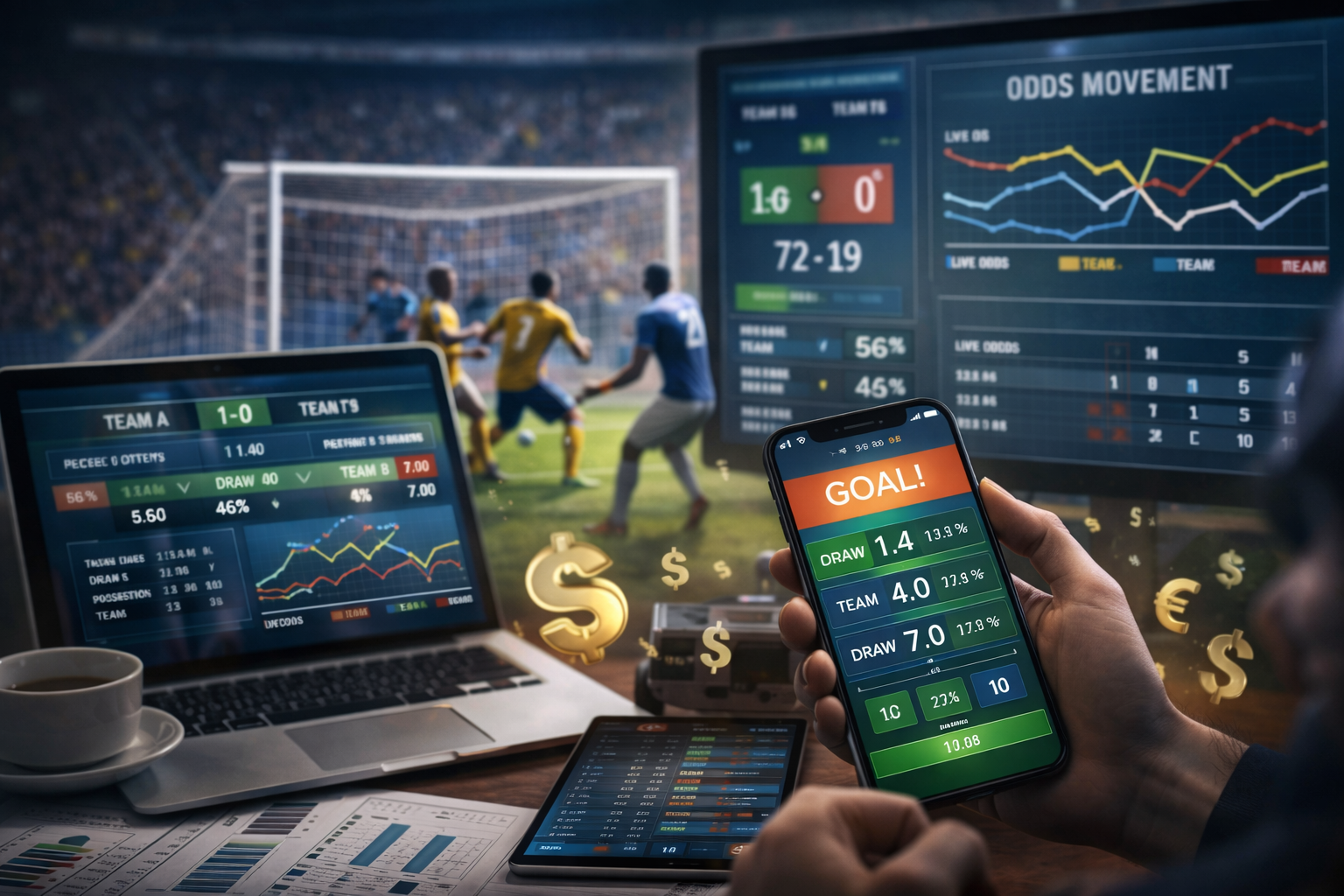
A goal instantly reshapes the market. Odds move within seconds. Liquidity relocates across markets. Betting behavior changes faster than any pre-match model predicts.
Platforms and apps with real-time visualization such as 1xbet mobile display how prices, active lines, and liquidity adjust immediately after a goal. Most short-lived inefficiencies tend to emerge during the first minute following the event.
The Immediate Market Reaction After a Goal
Markets do not “pause and think” after a goal. They recalculate probability mechanically.
A goal changes how matches are managed rather than just how they are scored. Teams that take the lead often reduce forward risk, slow restart tempo, and protect central zones, while trailing sides increase vertical passes and accept defensive exposure. Betting markets adjust to this shift by redistributing probability across outcomes tied to possession control, transition frequency, and late-game pressure. As these tactical responses unfold unevenly, pricing briefly reflects uncertainty rather than settled expectation. This interaction between strategic adjustment on the pitch and probabilistic recalibration off it defines the short window where live markets remain most sensitive to new information.
Independent monitoring groups that analyze live sportsbook feeds recorded average matched volume spikes between 260% and 390% during the first 60 seconds after a goal across high-liquidity competitions. The spike is strongest in match result, next goal, and total goals markets.
Odds adjustment speed has also changed. Five years ago, full repricing across core markets often took 6–9 seconds. Current tracking shows full synchronization under 2.8 seconds on large operators. Smaller markets still lag by 8–15 seconds.
That delay is not theory. It is measurable infrastructure behavior.
Liquidity Does Not Increase Evenly
More money enters the market after goals. It does not spread evenly.
Roughly 72% of post-goal volume concentrates into three markets:
- Match result (1X2)
- Over/under totals near key lines
- Next goal scorer or next team to score
Secondary markets such as corners, offsides, or player props absorb liquidity later, often 90–180 seconds after the goal. This time gap repeatedly appears in exchange-level datasets.
That is why professionals do not chase the loudest markets. They monitor where money has not arrived yet.
Measurable Market Changes After a Goal
| Market signal | What actually happens |
| Odds compression | Favorites shorten by 18–35% on average after scoring first |
| Volume spike | Turnover during first minute grows by 260–390% |
| Market suspension | Main lines pause for 2–5 seconds on high-liquidity platforms |
| Overreaction zone | Public money pushes some prices 6–12% beyond fair value |
| Lag in secondary lines | Corners, cards, props adjust 8–15 seconds slower |
| Liquidity relocation | Capital shifts from pre-match into in-play pools |
These patterns repeat across thousands of fixtures every season.
Statistical Footprints
Public behavior is not random. It leaves data trails.
When an underdog scores first, more than 64% of retail volume during the next two minutes targets the favorite comeback. When a favorite scores first, 71–76% of retail volume flows into win markets despite compressed value.
Behavioral finance research across financial markets shows that emotional events increase transaction frequency by roughly 30–40%. Live football mirrors this effect almost perfectly. Goal events function as emotional triggers.
Professional traders do not fight that behavior. They track its timing.
Why Timing Beats Prediction
Trying to predict goals consistently fails. Measuring reaction timing does not.
Latency testing across several platforms shows a clear difference between event detection and market repricing:
- Main 1X2 odds update: 0.7–2.8 seconds
- Totals market update: 1.2–4.6 seconds
- Corner and card markets update: 6–15 seconds
That means inefficiency windows are structural. They do not depend on opinion. They depend on platform architecture.
When automated pricing models, delay buffers, human traders, and massive public order flow collide in the same thirty-second window after a goal, price formation becomes temporarily unstable even on highly efficient platforms, which explains why certain markets consistently lag behind the new probability.
High-Scoring Matches Create Predictable Volume Patterns
Matches with multiple goals do not behave like low-scoring games.
Tracking across large datasets shows that fixtures with four or more goals generate 70–85% higher total in-play turnover than low-scoring matches. The fourth goal usually produces the largest relative volume jump, not the first.
Public money also shifts behavior. After three goals in the first half, over bets attract disproportionate volume even when implied probability exceeds 80%. That bias appears consistently.
Market efficiency increases. Behavioral predictability also increases.
Common Analytical Errors When Interpreting Volume
Many players see volume and draw wrong conclusions.
The most frequent analytical mistakes appear repeatedly in market studies:
- Assuming high volume confirms price accuracy
- Ignoring the difference between retail flow and sharp flow
- Treating price movement as information rather than reaction
Exchange research across long samples shows that markets dominated by retail volume close further away from true probabilities than markets dominated by professional liquidity. More activity does not automatically mean better information.
Volume must be interpreted, not trusted.
Why Professionals Track Stability, Not Excitement
Professionals measure how long it takes for a market to stabilize after a goal.
On efficient platforms, price oscillation usually stops between 90 and 140 seconds after a goal. On weaker platforms, instability lasts up to four minutes. That window determines whether inefficiency still exists.
They also measure how much the line overshoots before correction. In many datasets, public-driven overshoots reach 8–14% before partial reversion occurs.
By mapping price deviation against time-to-stability across thousands of live events, experienced players build internal benchmarks that tell them when a market has overreacted mechanically versus when it has simply adjusted correctly to new probability.
What Actually Drives Sustainable Edge
Long-term success does not come from faster clicking. It comes from understanding structure.
The players who last are the ones who know where volume arrives first, where it arrives last, and how public behavior distorts pricing in narrow windows. They track latency. They track reaction curves. They track behavioral bias.
Live football betting is not chaos. It is structured volatility.
And once you see the structure, you stop chasing goals and start observing markets.


