


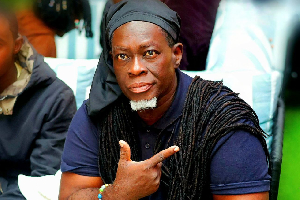

Renowned Ghanaian reggae musician Julius Amua-Sekyi, popularly known as Shasha Marley, has detailed how a coup initiated by Flight Lieutenant Jerry John Rawlings destroyed the music industry in Ghana.
Speaking in an interview with Kafui Dey, the musician detailed how he used to be part of a band that usually toured parts of Ghana.
He described the bustling nightlife industry, which saw various music bands continuously tour the country, sometimes bumping into each other.
“Highlife used to be everywhere in Ghana. I was part of a Highlife band, and we used to tour the country. We could be travelling to the Volta Region for a show, and we would run into Nana Ampadu and his band coming from there. At the same time, JA Adofo would be passing somewhere. At that time, the music business in Ghana was number one in Africa,” he recalled.
The good times, according to Shasha Marley, came to a halt on June 4, 1979, after a coup led by Flight Lieutenant Jerry John Rawlings and the Armed Forces Revolutionary Council (AFRC).
The party immediately imposed a dusk-to-dawn curfew as part of a nationwide lockdown to consolidate power.
The curfew was lifted shortly after on June 6, 1979, until Rawlings later staged another coup on December 31, 1981, which introduced a much longer, continuous, and severe curfew lasting for over a year.
According to Shasha Marley, the curfews destroyed the nightlife and, by extension, the music industry, which relied mainly on performances.
“For me, the 1979 coup disengaged the nightlife in Ghana. There was a long curfew, which affected the nightlife.
“So that time, most of the musicians and their bands ended up travelling to Nigeria and then to Europe. By the time the curfew was lifted, there was no one left to revive it,” he detailed.
JJ’s ‘79 coup destroyed bands in Ghana – Ambolley
Shasha Marley’s narration echoes that of popular Ghanaian Highlife musician Gyedu-Blay Ambolley, who, in a 2016 interview, also shared how the 1979 coup and the curfews affected the music industry.
“When he [Rawlings] did the coup, there was a curfew continuously for two years and over, which killed nightlife in Ghana. The musicians who also made a living left for Nigeria, Abidjan and Europe,” he was quoted as saying in the interview.
The 1979 coup
The 1979 Ghanaian coup, known as the June 4th Uprising, was a military revolt led by Flight Lieutenant Jerry John Rawlings that ousted the Supreme Military Council II, led by General Fred Akuffo.
Fuelled by economic hardship, corruption, and junior officer frustration, they established the Armed Forces Revolutionary Council (AFRC), executing former heads of state before handing over to a civilian government.
Before the coup, Rawlings and other soldiers were arrested after a failed mutiny on May 15, 1979. He was sprung from prison on June 4, 1979, by soldiers.
The regime executed eight military officers, including former heads of state General Ignatius Kutu Acheampong and General Fred Akuffo.
The AFRC ruled for only 112 days before Rawlings voluntarily handed over power to Dr Hilla Limann of the People’s National Party (PNP) on September 24, 1979 after an election.
However, the economic issues persisted, leading Rawlings to stage a second, more permanent coup on December 31, 1981.
Watch the video below:
The music business in Ghana was number one in Africa but 1979 Coup disengaged nightlife, ending up destroying a thriving music industry – @ShashaMarleyGH
Full interview here https://t.co/GqczTlpXLo#KafuiDeyInterviews pic.twitter.com/B6UzMlOE3W
— Kafui Dey (@KafuiDey) February 6, 2026
ID/EB


