


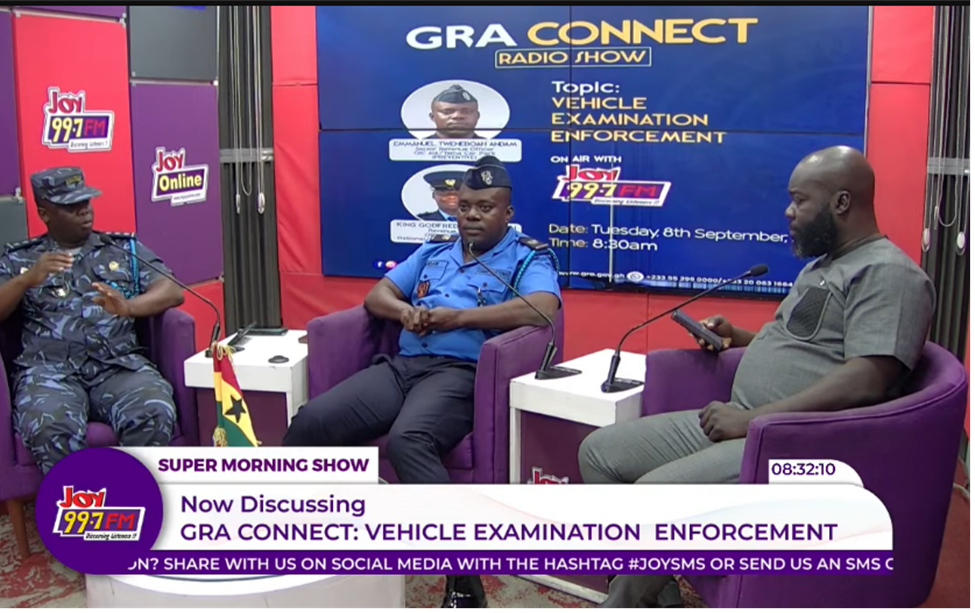
The Ghana Revenue Authority (GRA) has urged prospective vehicle buyers to verify the customs status of a vehicle before paying for it, warning that a Ghanaian registration number does not necessarily mean the vehicle has been properly cleared.
The Authority says buyers should take both the vehicle and its registration documents to the nearest Customs office for physical verification before completing a purchase.
Speaking on Joy FM’s Super Morning Show on September 8, Emmanuel Tweneboa, Senior Revenue Officer in charge of Preventive at the Accra International Airport Terminal Car Park, cautioned buyers against relying solely on documents provided by vehicle sellers.
“Giving you the vehicle and the registration documentation does not guarantee that the vehicle is customed,” he cautioned.
Mr Tweneboa advised prospective buyers not to simply send a Bill of Entry (BOE) or entry number to a Customs officer or another person for verification.
He explained that the physical vehicle must be presented together with its documents to enable Customs officers to confirm that the vehicle’s identification details correspond with the information contained in Customs records.
Customs conducts physical checks
According to Mr Tweneboa, Customs conducts physical examinations of vehicles as part of the verification process.
He said officers also use an On-Board Diagnostics (OBD) machine to check vehicle details and determine whether they correspond with the documentation and Customs records.
“If it’s genuine, Customs will just give you the go-ahead, and you can now purchase the car,” he said.
He therefore urged buyers to make Customs verification an essential step before making payment for any used vehicle.
Revenue Officer in charge of the National Vehicle Task Force, King Godfred Akorligleh, similarly advised prospective buyers to insist that sellers accompany them to Customs with the vehicle and its documents.
He warned that failure to carry out the necessary checks could result in buyers losing both the vehicle and the money paid for it.
Foreign or Ghanaian registration not enough
The GRA explained that although Customs officers are stationed at Driver and Vehicle Licensing Authority (DVLA) offices to authenticate vehicle details during the registration process, some individuals still attempt to manipulate the system.
Mr Tweneboa said Customs had encountered cases involving tampered Vehicle Identification Numbers (VINs) and other alterations intended to make vehicles that had not been properly cleared appear legitimate.
He therefore urged the public to carry out independent verification before purchasing any used vehicle, regardless of whether it has already been registered in Ghana.
“Anytime, any day, if you want to buy any vehicle, we are just appealing to the general public: take the documents with the vehicle, come to Customs,” he said.
The GRA is encouraging prospective buyers to complete the Customs verification process before making payment, rather than relying on the seller’s documents or the vehicle’s registration status as proof that all customs obligations have been met.
DISCLAIMER: The Views, Comments, Opinions, Contributions and Statements made by Readers and Contributors on this platform do not necessarily represent the views or policy of Multimedia Group Limited.
DISCLAIMER: The Views, Comments, Opinions, Contributions and Statements made by Readers and Contributors on this platform do not necessarily represent the views or policy of Multimedia Group Limited.
Source link
