


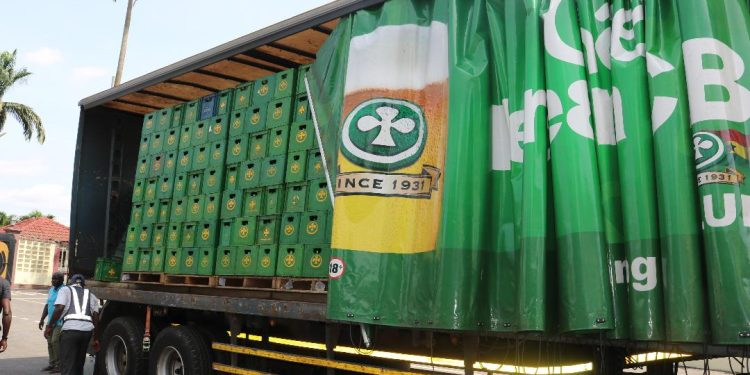
The government has rejected Accra Brewery PLC’s claim that changes to Ghana’s beer excise duty regime could put up to 2,000 jobs at risk, saying the company has not provided sufficient evidence to support the estimate.
Accra Brewery recently warned that the revised excise rates could increase the tax burden on locally produced beer, affect investment and give imported beer an advantage.
The company estimates the changes could add US$7.5 million to its costs and has called for the existing sliding-scale rates to be maintained for the 2026 and 2027 financial years.
In a rejoinder issued on Monday, August 31, 2026, the Ministry of Finance said the key issue was whether the existing tax concession was still achieving its intended purpose.
Data from the Ghana Revenue Authority, it said, showed that about 85% of qualifying production by Accra Brewery and other local manufacturers was already being assessed in the highest concessionary band.
Under the previous regime, producers with more than 70% local raw material content paid a 10% excise rate.
“A graduated incentive works by creating a marginal reward for movement between bands,” the ministry said.
“Where 85% of output has already reached the highest band, there is no further band to move to and no marginal inducement left to offer.”
Under the revised Excise Act, the three-band structure remains, but the rate for beer and stout containing more than 70% local raw materials has increased from 10% to 25%.
The rate for products containing between 50% and 70% local raw materials has also risen from 32.5% to 40%, while the standard rate remains 47.5%.
The ministry said the changes therefore reduce the size of the tax preference rather than abolish it. Producers in the highest band will still have a 22.5 percentage-point tax advantage over imported beer, which remains subject to the 47.5% standard rate.
The government also challenged ABL’s projection that up to 2,000 jobs could be lost.
It said the company had not provided the methodology, base year, price elasticity or definition used to determine the number of jobs considered to be “at risk”.
“The publication asserts the conclusion and supplies none of the intermediate steps,” the ministry said.
It also disputed the use of an Oxford Economics estimate that the beer industry supported 52,000 jobs in 2023, saying that figure represented the sector’s wider economic footprint rather than jobs specifically dependent on the excise concession.
The ministry said the relevant assessment should compare employment under the revised tax rates with the previous 10% concession, rather than consider the potential impact on the beer industry as a whole.
The government also questioned ABL’s US$7.5 million estimate of the additional cost arising from the tax changes.
It said the company had not disclosed the production volumes, ex-factory prices, product mix, applicable tax bands, exchange rate or assumptions on whether the higher duty would be passed on to consumers.
The ministry has therefore asked ABL to provide the calculation in Ghana cedis and reconcile the figure with its audited financial statements.
DISCLAIMER: The Views, Comments, Opinions, Contributions and Statements made by Readers and Contributors on this platform do not necessarily represent the views or policy of Multimedia Group Limited.
DISCLAIMER: The Views, Comments, Opinions, Contributions and Statements made by Readers and Contributors on this platform do not necessarily represent the views or policy of Multimedia Group Limited.
Source link


