


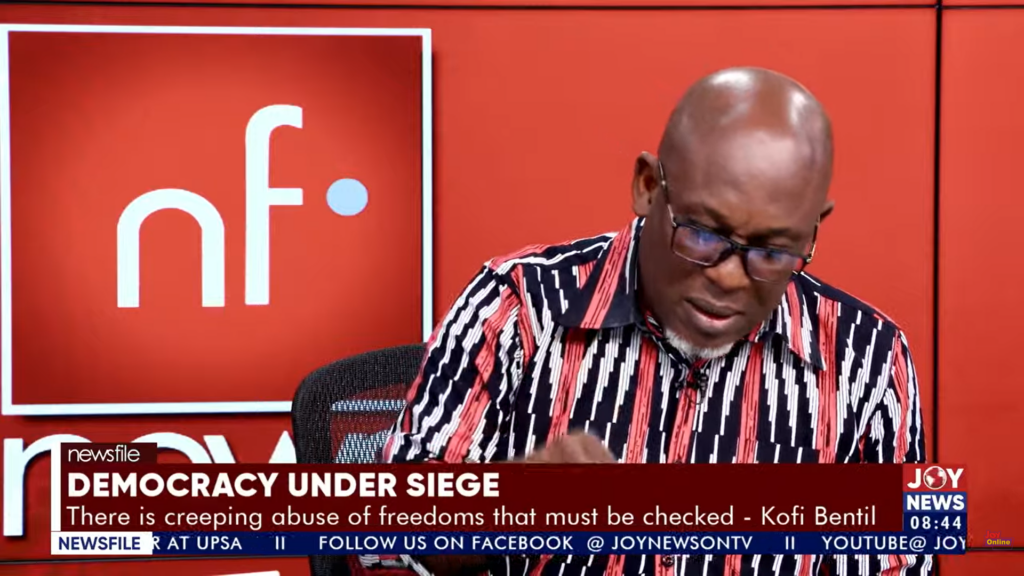
Senior lawyer and Vice-President of IMANI Africa, Kofi Bentil, has warned that attacks on democracy rarely happen abruptly, arguing that the gradual erosion of constitutional freedoms and institutions could pose a serious threat to Ghana’s democratic stability.
Speaking on JoyNews’ Newsfile on Saturday, August 8, Mr Bentil said democratic systems could be weakened from within when laws and state institutions are gradually used in ways that undermine constitutionalism.
His comments followed Thursday’s “Democracy Under Attack” demonstration organised by the opposition New Patriotic Party (NPP) in Accra.
Thousands of NPP supporters and party officials took to the streets to protest what the party described as threats to Ghana’s democratic institutions under the governing National Democratic Congress (NDC) administration.
The demonstration ended with the NPP presenting a petition at the forecourt of Jubilee House, the seat of government.
The party’s delegation was led by Minority Leader Alexander Afenyo-Markin, General Secretary Osei Kyei-Mensah-Bonsu and the Chief of Staff to NPP flagbearer Dr Mahamudu Bawumia.
The NPP had also earlier submitted a separate petition to the Supreme Court.
Against this backdrop, Mr Bentil urged Ghanaians not to dismiss concerns about democratic backsliding simply because they emerge through isolated incidents.
According to Mr Bentil, the erosion of democracy is often a gradual process which can be difficult to detect until institutions have already been significantly weakened.
“When you talk about an attack on democracy, never in the history of mankind happens suddenly. It creeps on you as a nation,” he said.
He referred to historical examples to illustrate his argument, recalling a lecture he delivered in Germany on the dangers of democratic backsliding.
Mr Bentil said Adolf Hitler and Benito Mussolini were able to use democratic principles and political processes to gain power before subsequently using state structures and laws to dismantle constitutional safeguards.
“I was explaining to the white people that Hitler and Mussolini used democratic principles to enter office and then when they got into office, they used laws and other [things] that are supposedly part of the democratic system to cancel out constitutionalism and the democracy they had,” he said.
His argument was that democratic decline does not necessarily begin with the outright abolition of elections or the formal suspension of a constitution.
Rather, it can start when institutions, laws and established democratic practices are gradually manipulated or weakened.
“And everywhere people had been oppressed, it starts slowly,” he added.
The IMANI Africa Vice-President also defended the role of activists and protesters in safeguarding democratic freedoms.
He argued that citizens should respect people who participate in demonstrations even when they disagree with their political views or the specific demands of their protests.
“It is the activist you saw on the road who pushed the boundaries of freedom and democracy and make your liberty assured,” he said.
Mr Bentil said activism should not be judged solely on whether the public agrees with the message being advanced.
“When you see people demonstrating, whether you agree with them or not, first have the respect for the fact that they put themselves on the line to push the boundaries of our democracy,” he said.
“You may not agree with them, but respect their activism.”
Mr Bentil said the current concerns should not be ignored because democratic decline, in his view, often occurs incrementally.
“We have a creeping situation which can get worse,” he warned.
For Mr Bentil, vigilance is particularly important because once restrictions on democratic freedoms become normalised, reversing them can become increasingly difficult.
Mr Bentil also spoke about his own experience during the NPP demonstration.
He claimed that he was assaulted by police officers while attempting to get close to the Jubilee House gate.
“This is an improvement because I was beaten up. I had been attacked by policemen trying to get close to Jubilee House gate,” he said.
Mr Bentil used the incident to reinforce his argument that activism and peaceful protest remain important safeguards within a democracy.
His position is that even when a demonstration is politically contentious, the fundamental rights of those participating should be respected.
The senior lawyer also raised concerns about what he described as apparent selectivity in the administration of justice.
He questioned why certain individuals appeared to receive “special treatment” in circumstances where others might face different consequences.
“Today, there are questions of why are some people being singled out for that special treatment,” he said.
“So I think as a matter of fact there is some selectivity in justice.”
DISCLAIMER: The Views, Comments, Opinions, Contributions and Statements made by Readers and Contributors on this platform do not necessarily represent the views or policy of Multimedia Group Limited.
DISCLAIMER: The Views, Comments, Opinions, Contributions and Statements made by Readers and Contributors on this platform do not necessarily represent the views or policy of Multimedia Group Limited.
Source link


