


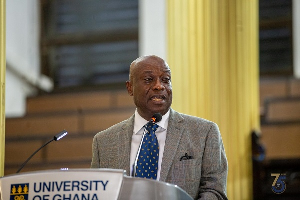

A veteran industrialist and former President of the Association of Ghana Industries (AGI), Tony Oteng-Gyasi, has urged government to seize what he describes as a “once-in-a-century opportunity” to build a manufacturing-led economy, as the global trade order increasingly shifts towards protectionism.
He made the call at the investiture ceremony of the newly elected leadership of the Association of Ghana Industries.
Oteng-Gyasi stressed that the emerging global trade environment should not be viewed as a threat, but rather as an unprecedented opportunity for Ghana to pursue a self-reliant industrialisation agenda anchored in manufacturing.
“I think this is an opportunity for the country to launch a full-scale industrialisation agenda,” he said, adding that “we lost out in the 1960s and 1970s when our peer countries in Asia embarked on their industrialisation drive.”
He noted that Ghana has recently achieved some measure of macroeconomic stability, with inflation falling sharply from 23.8 percent in December 2024 to 5.4 percent at the end of 2025. The cedi, he observed, also appreciated by 32.2 percent against the US dollar — a first in decades.
These gains, he said, informed the Bank of Ghana’s decision to cut the policy rate aggressively to 18 percent by the close of 2025. Consequently, the Ghana Reference Rate declined to 15.68 percent in January 2026, signalling a gradual reduction in the cost of borrowing — a trend analysts expect to persist through the year.
Oteng-Gyasi therefore argued that “this is a unique moment — a once-in-a-century opportunity — to allow manufacturing to grow and thrive as the bedrock of the economy”.
He further pointed to the resurgence of protectionist policies globally, particularly the open use of tariffs by advanced economies to influence trade flows, citing recent tariff actions by US President Donald Trump.
“Africa, under the globalisation agenda, was largely positioned as a supplier of raw materials and a market for manufactured goods,” he observed.
However, he contended that the current fragmentation of global trade offers both the political and economic justification for Ghana to decisively turn inward, add value to its raw materials, and build a resilient industrial base.
The Chief of Staff, Julius Debrah, acknowledged that “policies alone will not transform the economy”, while outlining steps government has taken to support industrialisation.
He cited declining inflation, a stabilising currency, and ongoing reforms in regulation, SME financing and critical infrastructure as key enablers, adding that government is committed to doing its part.
Debrah called for deeper collaboration with the private sector to achieve tangible outcomes, assuring industry players of a “responsive, predictable and accountable” public sector.
Meanwhile, Managing Director of Kinapharma Group, Dr Kofi Nsiah-Poku, was sworn in as the new President of AGI, succeeding Dr Humphrey Ayim-Darke.
In his maiden address, Dr Nsiah-Poku outlined a five-pillar strategic plan aimed at operationalising the industrial push. The plan includes close collaboration with the government’s 24-Hour Economy Secretariat, the establishment of a dedicated export advisory department, and an aggressive drive to double AGI’s membership while making it “innovative, formalised and export-oriented”.
However, Oteng-Gyasi cautioned that the country needs a “proper and well-thought-out manufacturing agenda” that goes beyond policy documents to include detailed cost structures, revenue projections and job-creation analysis.
“We truly have your work cut out for you, for the sake of our youthful and growing population,” he told the new AGI leadership, urging them to leverage the recently inaugurated Presidential Advisory Group on the Economy — which includes industry leaders such as Ishmael Yamson and Togbe Afede — to craft a practical and actionable industrial blueprint.


