


Cocoa prices have risen by 95.1% since the beginning of March 2026, as fears of reduced crop yields in the 2026/27 season have pushed prices higher.
According to Fitch Solutions, higher cocoa prices will partly offset lower production volumes in nominal export terms.
El Niño’s adverse weather conditions is expected to place downward pressure on the 2026/27 cocoa output, forecasting cocoa production of 1.7 million tonnes in Côte d’Ivoire and 670,000 tonnes in Ghana.
This implies greater near-term supply pressure in Côte d’Ivoire, where output is forecast to decline by 17.5% year-on-year, while Ghana’s production is expected to remain flat, the UK-based firm said.
“Our Agribusiness team now forecasts cocoa prices to average US$4,990/tonne in 2026 and USD5,670/tonne in 2027 which, while below the levels seen in 2024 and 2025, are well above the 2014-2023 average of US$2,642/tonne”.
According to Fitch Solutions, the benefit will be most pronounced in Nigeria and Cameroon, where liberalised pricing mechanisms allow domestic prices to move more closely with global cocoa prices.
By contrast, gains will be more muted in Côte d’Ivoire and Ghana, where government-operated pricing mechanisms determine domestic cocoa prices. Both Côte d’Ivoire and Ghana also forward sell their cocoa crop, usually three-to-six months ahead, which means there will be a lag before higher prices are reflected.
Elevated Cocoa Prices Will Aid Nominal Exports Somewhat
It continued that higher cocoa prices also increase the incentive for farmers in Ghana and Côte d’Ivoire to sell outside official channels, which could amplify export losses in both markets.

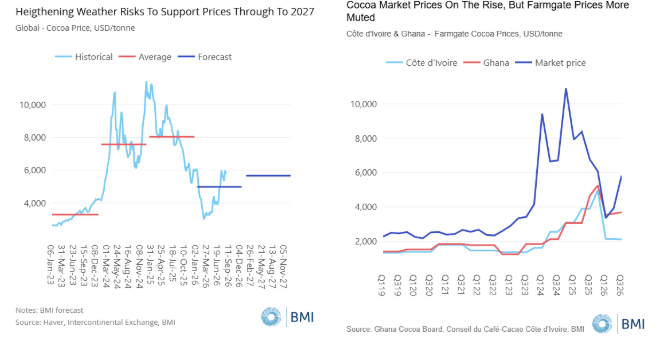
“When global prices rise well above domestic farmgate prices, farmers have a stronger incentive to move cocoa into neighbouring countries where they can capture higher returns. In both 2024 and 2025, when global cocoa prices reached record highs, neighbouring economies such as Guinea and Togo saw steep increases in cocoa exports despite not possessing large domestic cocoa industries. A renewed rise in smuggling would therefore further reduce officially recorded cocoa exports from Ghana and Côte d’Ivoire”, it mentioned.
DISCLAIMER: The Views, Comments, Opinions, Contributions and Statements made by Readers and Contributors on this platform do not necessarily represent the views or policy of Multimedia Group Limited.
DISCLAIMER: The Views, Comments, Opinions, Contributions and Statements made by Readers and Contributors on this platform do not necessarily represent the views or policy of Multimedia Group Limited.
Source link


