


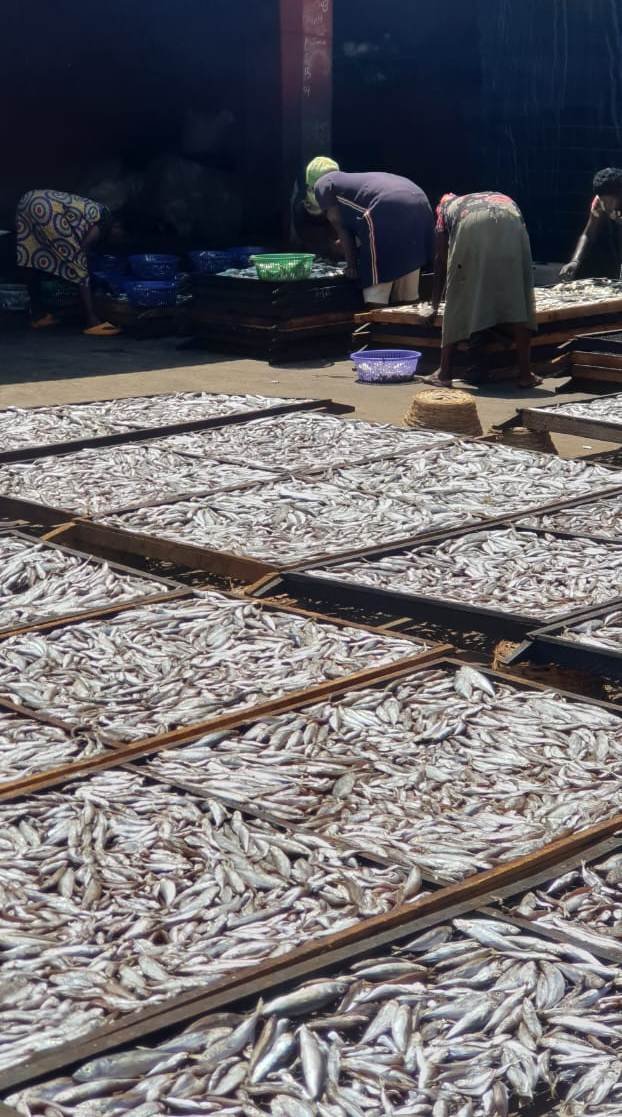
GOVERNMENT’S close season has begun yielding tangible dividends along the country’s coastline, with recent field observations at Elmina revealing that fishers returning from authorised expeditions are landing remarkably fresh and viable catches.
Mr Stephen Asempa, the Acting Municipal Director of Fisheries for the Komenda-Edina-Eguafo-Abrem (KEEA) Municipal Assembly, disclosed that municipal enforcement teams have maintained a strict, round-the-clock presence at landing beaches to root out illegal, unreported, and unregulated (IUU) fishing.
According to him, a central battleground in the campaign is the eradication of light fishing and destructive gear, stressing that fisheries officers routinely patrol landing beaches and intercept generators brought down to canoes, treating the unauthorised presence of such equipment near shorelines as a clear indicator of impending illegal light fishing.
“Even when fishers claim seized generators are faulty or intended for repairs, authorities maintain a zero-tolerance policy, seizing the items upon approach to deter violations,” he indicated.
These ground realities came to light when members of the Ghana Agricultural and Rural Development Journalists Association (GARDJA) embarked on a comprehensive reporting visit to the Elmina Harbour.
The tour on Friday formed part of ongoing field engagements under the ‘Save Our Seas Project’, an initiative supported by the Earth Journalism Network (EJN) to strengthen environmental journalism in Ghana by spotlighting the state of coastal ecosystems and the collaborative efforts required to protect them.
In tandem, the enforcement of the ban on monofilament nets—a core pillar of the current fisheries management strategy—is facing strict adherence. Officials have made it clear that fishers utilising prohibited gear will find no recourse for compensation even if they suffer accidental damage at sea, reinforcing the heavy financial and legal risks of non-compliance.
Kwesi Tawiah, representing the Chief Fisherman of the Ghana National Canoe Fishermen Council, praised the government for the close season concept, noting that it had resulted in bumper harvests to the extent that fish prices had fallen dramatically, even though the initiative was initially very tough for fishers to accept.
The close season spanned from July 1 to August 1. He urged the government to ensure reduced premix fuel costs to ease their operational burden.
On the use of monofilament nets, he indicated that fishers were still struggling because they were yet to receive the state-approved alternative nets. Saiko fishing, he added, remained a major challenge in the industry, prompting fishers to set up their own monitoring teams to watch trawling activities.
On her part, Mrs Beauty Deku, a fishmonger/processor, also commended the government for the close season, noting that it had yielded an abundance of fish.
FROM KINGSLEY E. HOPE, ELMINA


