


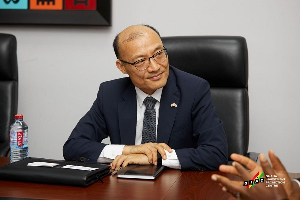

China is deepening its cooperation with Ghana in the mining sector, with a strong focus on technology transfer, responsible investment and building long-term, sustainable industrial capacity.
Tong Defa, Chinese Ambassador to Ghana, said the partnership is geared toward helping Ghana maximise the economic and social benefits of its mineral resources.
Ambassador Tong made the remarks during a three-day training workshop organised by the Ghana News Agency (GNA) for editors and reporters with support from the Association of China-Ghana Mining LBG, where he engaged journalists on sustainable resource governance and China–Ghana relations.
He noted that although Ghana possesses significant mineral wealth, the country continues to face difficulties in transforming these resources into broad national development.
“Ghana is not able to turn its natural resources into the full benefits for social development, and that is why China hopes that through our bilateral cooperation we can help establish a complete industrial chain in the mining sector,” he said.
He cited the operations of Chinese-linked mining firms such as Greenfield Goldmine and Shandong, which rely on Chinese technology and equipment to enhance efficient and responsible mineral production.
Such partnerships, he said, contribute to job creation, expand infrastructure and strengthen local value addition.
He further noted ongoing cooperation discussions between a Chinese provincial delegation and the Ministry of Lands and Natural Resources, could lead to a Memorandum of Understanding covering geological survey, environmental management and sustainable sector
On green mining, Ambassador Tong explained that it offers a viable path to reducing environmentally harmful artisanal mining.
He noted that modern mining technologies enable land reclamation, reduce water pollution and promote regulated community involvement.
Emmanuel Armah-Kofi Buah, the Minister of Lands and Natural Resources in an address read for him said government is commitment to advancing green mining and strengthening environmental protection as part of a renewed national effort to combat illegal mining and safeguard Ghana’s natural resources.
He pointed out that there is an urgent need to reduce the environmental consequences of mining particularly water pollution, air pollution and land degradation.
According to him, mining remains an important pillar of the economy, but warned that without strong regulation and sustainable practices, it poses serious threats to national development and public safety.
He noted that green mining is the future of Ghana’s mineral. Green mining prioritises renewable energy use, waste reduction, water conservation, mercury-free technologies, resource efficiency, community engagement, post-mining land restoration, and carbon footprint reduction.
He stressed that scaling up such practices is essential to eliminating illegal mining, popularly known as malmsey, causing massive ecological destruction and severe socio-economic harm.
The Minister cited the Minerals and Mining Act, 2006 (Act 703), as amended, and the Environmental Protection Act, 2025 (Act 1124), as key legal frameworks strengthening Ghana’s fight against illegal mining.
He also referenced Ghana’s commitments to major international environmental treaties, including the UN Framework Convention on Climate Change, the Paris Agreement and the Vienna Convention for the Protection of the Ozone Layer is further evidence of the nation’s dedication to environmental stewardship.
“These conventions, treaties and national laws are testament to Ghana’s resolve to uphold responsible mining practices,” he emphasised.
“Green mining is a shared mission, let us adopt practical reporting checklists, engage with credible data sources, and sustain multi-stakeholder conversations that keep the public informed and protected” he concluded.


