


Africa must move beyond merely adopting artificial intelligence (AI) technologies developed elsewhere and take a leading role in determining how the technology is designed, governed and deployed on the continent, the Spokesperson and Press Secretary to the Vice-President, Ama Pratt, has said.
She said Africa’s future in the rapidly evolving AI landscape would depend not only on its ability to use existing technologies but also on whether it could develop the skills, infrastructure, institutions and policies required to shape AI around African realities.
Ms Pratt made the call in a featured address at the 2026 edition of Nyansa Futures, a two-day conference organised by the Beyond AI Initiative at the Academic City University in Accra from August 14 to 15.

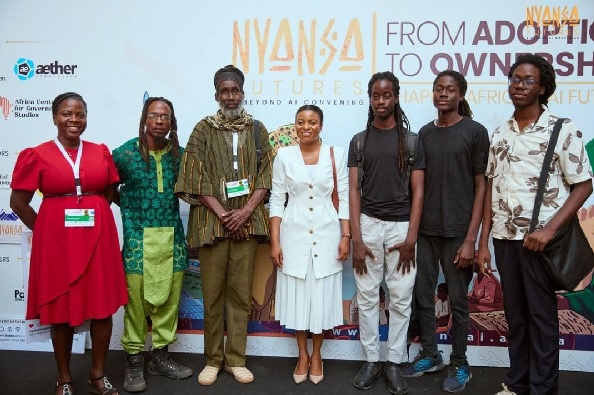
Speaking on the theme “From Adoption to Ownership: Shaping Africa’s AI Future”, she said the continent must ensure that African voices, knowledge, languages, communities and aspirations are reflected in the development of AI.
Her address, titled “Who Tells Africa’s AI Story?”, placed storytelling, public communication and inclusive participation at the centre of Africa’s emerging AI agenda.
She argued that whoever tells the story of technological development often influences how problems are understood, which solutions receive attention and whose experiences are recognised.
Beyond technology adoption
Ms Pratt said Africa could not afford to approach AI merely as a consumer of foreign technologies.
She said while Africans should learn from global technology companies and research institutions, the continent must equally ask questions that respond directly to its own development challenges.
“How can AI improve access to quality education in communities with limited resources?” she asked, while also pointing to possible applications in agriculture, healthcare, public communication, employment, cultural preservation and democratic participation.
She said ownership of AI would begin with Africans defining their own problems, developing appropriate solutions and building institutions capable of governing the technology and ensuring that its benefits were broadly shared.
That, she said, would require reliable connectivity, access to computing resources, stronger educational and research institutions, investment in local innovation, data protection systems and clear accountability standards.
AI and public trust
Ms Pratt also cautioned against viewing AI solely through the lens of technological opportunity, saying the technology could equally amplify misinformation and deepen existing inequalities if not responsibly governed.
She noted that AI systems could now generate articles, images, videos, voices and messages within seconds, while also creating opportunities for research, business, public administration, education and creative expression.
However, she warned that the same technologies could generate false information at unprecedented speed, imitate real people and make fabricated content appear credible.
She therefore urged journalists, public officials, technology companies, researchers and citizens to play their respective roles in building public understanding and confidence in AI.
“The media has a responsibility to investigate claims, question exaggerated promises and help the public understand both the opportunities and the risks,” she said.
She said citizens must also resist the temptation to circulate unverified information and demand accountability from institutions developing and deploying AI systems.
Women must be at the table
A significant part of Ms Pratt’s address focused on the need for women to participate fully in the development and governance of AI.
She said the exclusion of women from technology design, leadership, policymaking and resource allocation could result in systems that fail to reflect the experiences of half of the population.
“Women must be present,” she stressed, adding that the participation of women was essential if Africa was to avoid reproducing existing inequalities through new technologies.
She said AI development should take into account the experiences of women in agriculture, finance, education, the creative industries and public service, as well as women using technology to run businesses or access healthcare information.
Young people urged to take charge
Ms Pratt also challenged young Africans to see themselves as active participants in the AI revolution rather than passive users.
She urged young people to acquire technical skills while also developing an understanding of history, culture, law, ethics and human behaviour.
“If you are a programmer, remember that every line of code may eventually affect a human life,” she said, while urging entrepreneurs, researchers, journalists, artists and future public servants to approach AI development with purpose and responsibility.
She said young people needed to be present in laboratories, newsrooms, universities, government institutions, businesses and policy discussions where decisions about AI were being made.
Ms Pratt further encouraged the Beyond AI Initiative to continue creating platforms such as Nyansa Futures where policymakers, academics, innovators, students, civil society and communities could engage one another on the implications of emerging technologies.
She said no single institution could shape Africa’s AI future alone, stressing the importance of collaboration across government, academia, industry, civil society, the media and local communities.
She said Ghana, with its young population, growing technology ecosystem, educational institutions and tradition of public debate, had an opportunity to contribute meaningfully to an African AI model grounded in “dignity, inclusion, responsibility and wisdom”.
Ultimately, Ms Pratt said Africa’s AI future should be shaped by the people whose lives the technology would affect.
DISCLAIMER: The Views, Comments, Opinions, Contributions and Statements made by Readers and Contributors on this platform do not necessarily represent the views or policy of Multimedia Group Limited.
DISCLAIMER: The Views, Comments, Opinions, Contributions and Statements made by Readers and Contributors on this platform do not necessarily represent the views or policy of Multimedia Group Limited.
Source link


