


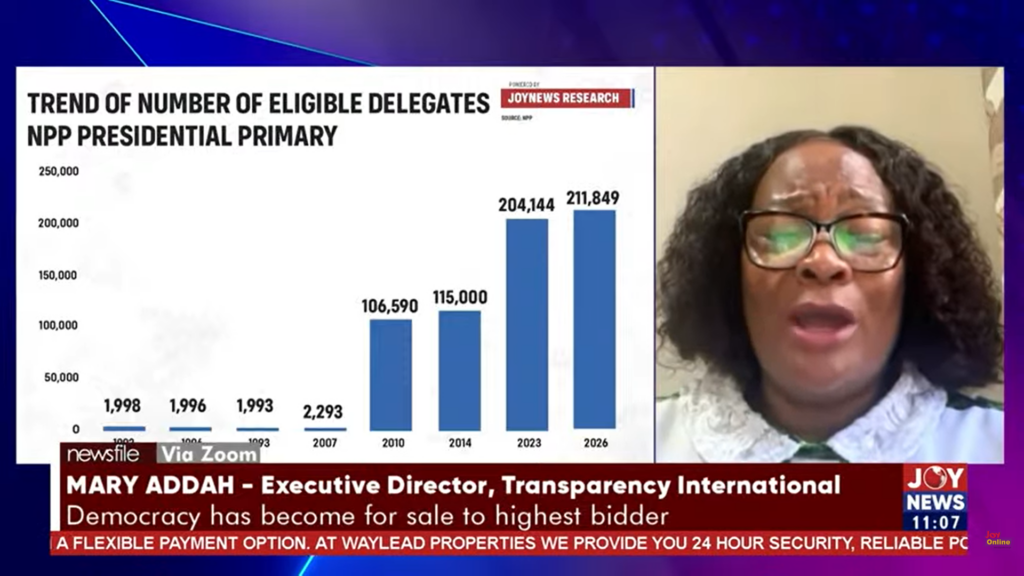
Executive Director of Transparency International Ghana, Mary Awelana Addah, has criticised politicians who dismiss allegations of vote-buying as mere speculation, insisting that the practice is a well-known feature of Ghana’s political landscape and should no longer be treated as an issue of conjecture.
Speaking on JoyNews’ Newsfile on Saturday, August 1, Ms Addah said the Supreme Court’s landmark ruling mandating a “one member, one vote” system for political party elections should be viewed against the backdrop of longstanding concerns over the influence of money in internal party contests.
According to her, claims by some politicians that vote-buying has not been proven are detached from the realities witnessed by Ghanaians and civil society organisations.
“They also live in Ghana, and they have seen, and when our politicians again say vote-buying is an issue of conjecture, I believe they are dreaming, and they are not facing the reality we have seen,” she said.
Her comments come days after the Supreme Court, in a 5–2 majority decision delivered on Wednesday, July 29, ruled that all registered members in good standing of political parties must be allowed to vote in the election of party leaders and candidates.
The judgment effectively abolishes the long-standing delegate system employed by Ghana’s major political parties and introduces a “one member, one vote” model for internal party elections.
The decision, delivered by a seven-member panel, concludes a constitutional challenge that sparked intense legal and political debate over democratic participation within political parties. It is expected to significantly reshape the conduct of future presidential, parliamentary and executive primaries.
Reflecting on the judgment, Ms Addah suggested that the Supreme Court’s decision was neither rushed nor taken without careful consideration of the country’s political realities.
“As for the promises, they are many, and so I believe that is why this is very instructive, and I am sure that the justices didn’t come to this conclusion easily,” she said.
She argued that the judges, like other Ghanaians, are familiar with the persistent allegations of vote-buying that have accompanied party primaries and internal political contests over the years.
The Transparency International Ghana Executive Director said her organisation and other civil society groups have documented numerous incidents pointing to the influence of money in politics, even though translating those observations into evidence capable of sustaining legal action has often proved difficult.
“We’ve captured [these incidents]; then again, they come at us that there is no evidence to substantiate this because the gaps in there are very weak,” she stated.
According to Ms Addah, the inability to secure conclusive legal evidence should not be interpreted as proof that vote-buying does not exist. Rather, she said, it highlights weaknesses in the country’s systems for investigating and proving electoral misconduct.
She maintained that denying the existence of vote-buying only delays meaningful reforms needed to strengthen Ghana’s democratic institutions and restore public confidence in the integrity of political processes.
While the practical implementation of the ruling is likely to present logistical and financial challenges, supporters argue that broadening participation could reduce the concentration of power in the hands of a relatively small group of delegates, a system that critics have long contended creates opportunities for inducements and vote-buying.
For Ms Addah, however, the starting point must be an honest acknowledgement of the problem.
She argued that meaningful electoral reform cannot be achieved if political leaders continue to dismiss concerns over vote-buying, insisting that recognising the reality of the practice is essential to developing stronger safeguards for transparency, accountability and democratic participation within Ghana’s political parties.
DISCLAIMER: The Views, Comments, Opinions, Contributions and Statements made by Readers and Contributors on this platform do not necessarily represent the views or policy of Multimedia Group Limited.
DISCLAIMER: The Views, Comments, Opinions, Contributions and Statements made by Readers and Contributors on this platform do not necessarily represent the views or policy of Multimedia Group Limited.
Source link
