


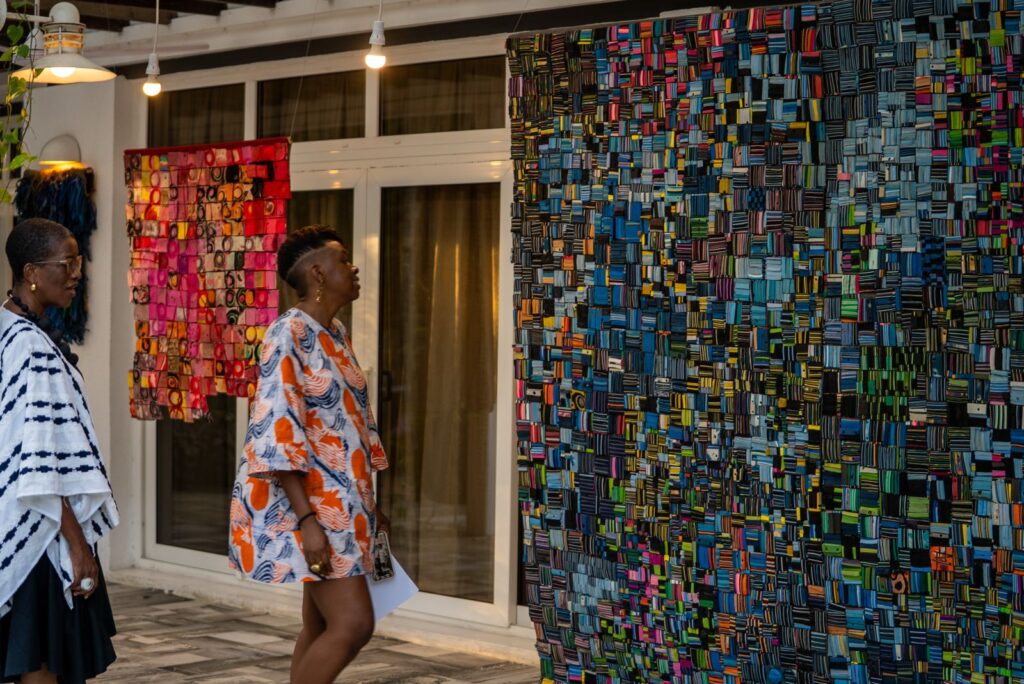
As part of activities to mark the 2026 World Maritime Day and the 10th anniversary of the Danish Maritime Security Programme for the Gulf of Guinea, the Royal Danish Embassy Accra presented “The Gulf of Guinea Speaks”, a site‑specific art intervention held at the Ambassador’s Residence in Accra.
Under the theme “From Policy to Practice: Powering Maritime Excellence”, three commissioned artworks brought human ‑ centered creative perspectives to the diplomatic maritime‑security discussions.
Curated by Fang Wang (Fang W. Linulf) and Essé Dabla‑Attikpo, the show featured Ghanaian artists Patrick Tagoe‑Turkson and Emmanuel Aggrey Tieku alongside a large‑scale floor work by Fang W. Linulf.
Tagoe‑Turkson repurposed beach‑collected plastic flip‑flops for mixed‑media assemblages addressing marine waste and coastal heritage. Aggrey Tieku also built monumental installations from salvaged second‑hand textiles to interrogate waste colonialism and global‑trade pollution. Fang’s 100 sqm floor print merges ocean imagery and maritime geographic data, letting visitors physically stand upon mapped Gulf‑of‑Guinea ocean geography.
Moving beyond official reports, the art intervention used sensory visual storytelling to highlight ocean ecology, coastal‑community realities and the human side of maritime governance for attending diplomats. Co – curator and artist Fang W. Linulf mentioned that visitors literally walk across the ocean on my floor print whilst abstract maritime data becomes something bodily and immediate.
She further stated that “policy builds frameworks for maritime security, yet art uncovers the human and material stories often missing from official documents. We wanted delegates to feel, not only read, the realities of the Gulf of Guinea coast.”
Essé Dabla‑Attikpo, also a co‑Curator “The Gulf of Guinea Speaks” stated that “waste arriving on our shores is not just an environmental problem. It carries global trade histories. Through re‑making discarded materials, we give visibility to these hidden narratives.”
Patrick Tagoe‑Turkson transformed ocean washed plastic flip‑flops collected from Ghana’s Atlantic shorelines into layered mixed‑media assemblages.
At the event, he said that “discarded flip‑flops and textiles washed onto our beaches hold cultural memories. Transforming waste into art is one way to advocate for our ocean and our coastal heritage.”
Commenting on the exhibition, Emmanuel Aggrey Tieku mentioned that “I work with second‑hand garments that end up in Ghana’s landfills and beaches. These textiles are physical evidence of waste colonialism and unequal global supply chains.”
The “The Gulf of Guinea Speaks” event was attended by maritime practitioners, diplomats and industry stakeholders and created a platform to experience maritime realities through sensory, material and visual perspectives, raising public awareness through artistic practice.
DISCLAIMER: The Views, Comments, Opinions, Contributions and Statements made by Readers and Contributors on this platform do not necessarily represent the views or policy of Multimedia Group Limited.
DISCLAIMER: The Views, Comments, Opinions, Contributions and Statements made by Readers and Contributors on this platform do not necessarily represent the views or policy of Multimedia Group Limited.
Source link


