


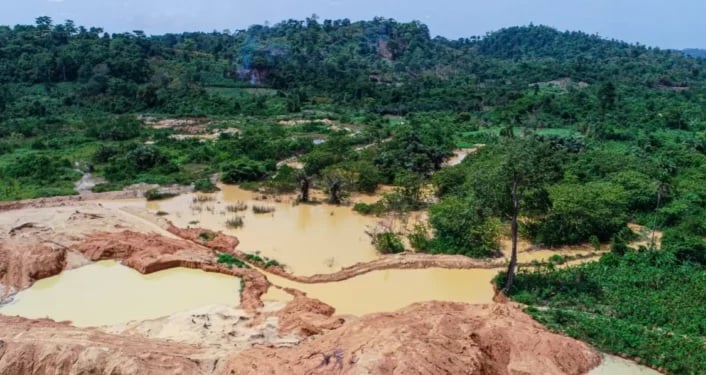
Ghana is Africa’s top gold producer. But as the country digs deeper for gold, it is confronting a different and potentially more consequential scarcity: clean water.
A new visual analysis by researcher and data visualisation analyst Fatah Maltaba Abass, titled Wealth Over Water: A Visual Analysis of Water Security and Environmental Governance Impacts of Illegal Gold Mining in Ghana, brings together data from the Water Resources Commission (WRC), Ghana Water Limited, COCOBOD, the Environmental Protection Agency (EPA), Pure Earth, the World Gold Council and peer-reviewed studies.
The analysis maps a growing tension at the heart of Ghana’s resource economy: the country is generating wealth from gold while putting some of the natural resources that support its population, agriculture and industry under increasing pressure.
One of the clearest examples is water.
Scientists at the CSIR-Water Research Institute reported in August 2026 that about 60% of Ghana’s water bodies are polluted, with illegal mining identified as a major contributor alongside agriculture, industrial activity, household waste and other human activities. The researchers warned that some affected water bodies could be difficult to restore even if the pollution stopped immediately.
That distinction matters. Galamsey is not the only source of Ghana’s water pollution — but in several mining-affected basins, its impact is particularly severe.
A country moving closer to water stress
The pressure is not coming from pollution alone. Ghana’s renewable water availability per person has fallen from about 3,000 cubic metres annually in the 1960s to 1,650 cubic metres today, according to the Ministry of Works, Housing and Water Resources.
The figure is below the 1,700 cubic metres per person threshold commonly used to indicate water stress.
At the same time, Ghana’s population has grown from roughly seven million people in 1960 to more than 30 million today. The implication is straightforward: there is less renewable water available per person, while demand continues to rise.
The Wealth Over Water analysis warns that continued deterioration could eventually push Ghana towards a future where it has to consider importing water. That should be treated as a warning scenario rather than a formal government forecast.
When rivers become too dirty to treat
The deterioration is visible in Ghana’s river systems. Turbidity — a measure of the amount of suspended material in water — has reached extraordinary levels in some mining-affected rivers.
The analysis records readings of 94,800 NTU on the Ayensu, 64,000 NTU on the Birim and up to 32,000 NTU on the Pra. Other affected rivers include the Offin and Ankobra. The figures are not simply an environmental concern. They directly affect the cost and efficiency of producing drinking water.
Ghana Water Limited has previously reported that extreme turbidity can force it to lose up to 50% of water during treatment, compared with a normal loss rate of about 5%.
More polluted raw water requires more treatment chemicals and can increase operational and maintenance costs. In some cases, the problem becomes severe enough to threaten the continued operation of treatment plants.
There have, however, been measurable improvements at some locations following enforcement operations. The analysis records turbidity reductions of 70% to 90% at selected monitoring points, including Densu/Nsawam.
The broader picture remains troubling: large sections of the country’s water resources continue to face contamination pressure.
The heavy metals behind the concern
The problem is not only mud. Research cited in the analysis identifies heavy metals including arsenic, lead and mercury in mining-affected environments.
Some studies have reported arsenic concentrations as high as 330 times national standards in specific contaminated locations, while lead and mercury have been recorded at levels many times above applicable safety limits. These figures need to be interpreted carefully.
They are site-specific measurements from contaminated locations, not evidence that Ghana’s entire water system contains those concentrations. But they illustrate the severity of contamination that can occur around poorly regulated mining and processing sites.
Mercury is particularly important because it can enter aquatic food chains and eventually reach people through fish consumption.
Cocoa is paying a price too
The damage does not stop at the riverbank. Galamsey has increasingly encroached on cocoa-growing areas, particularly in some of Ghana’s major producing regions. COCOBOD has reported that illegal mining has affected 81% of cocoa farmland in the Eastern Region, 74% in Western and 68% in Ashanti in areas assessed.
The impacts include destroyed cocoa trees, early pod dropping, wilting and yellowing leaves and reduced yields. But Ghana’s cocoa production decline should not be attributed entirely to illegal mining.
Weather conditions, swollen shoot disease, ageing farms and other structural challenges have also contributed significantly to the industry’s recent difficulties. The distinction is important because the data show galamsey as one component of a wider cocoa production crisis, rather than a single explanation for it.
The risk to farmland, however, is immediate: once a productive cocoa farm has been excavated, restoring it is far more difficult than preventing its destruction.
From shovels to excavators
The scale of the environmental damage has also changed as mining has become increasingly mechanized. In 2024, Ghana imported GH¢6.2 billion worth of excavators, according to the Lands Minister, making the machines one of the country’s largest import categories. The government subsequently introduced measures to track excavators and prevent their diversion into illegal mining.
The significance is simple. An excavator can disturb an area of land in hours that would take individuals with basic tools considerably longer to work. That changes galamsey from a collection of small pits into a potentially large-scale landscape transformation
By March 2026, the National Anti-Illegal Mining Operations Secretariat (NAIMOS) said its operations had resulted in the seizure of 94 excavators, the destruction of nearly 3,000 illegal mining sites and 237 arrests.
The figures demonstrate the scale of enforcement activity. They also raise another question: How much does Ghana spend fighting galamsey, and how much of that expenditure translates into lasting environmental recovery?
When the pollution reaches the food chain
The environmental damage can eventually become a food-safety issue. The analysis highlights studies reporting elevated concentrations of lead and mercury in food samples from mining-affected areas, including cassava, leafy vegetables, tomatoes and river fish. Among the reported results, lead in some tomato samples reached 48 times the applicable safety limit.
Again, these should not be interpreted as evidence that Ghanaian food generally contains dangerous levels of heavy metals. They are findings from specific samples and locations.
But they demonstrate a potential pathway particularly concerning for communities that depend directly on rivers for fishing, irrigation and household use.
Contaminated mining area → polluted water or soil → crops and aquatic life → human consumption.
The forest-water connection
The destruction also extends upstream. Forest reserves are important to Ghana’s water security because forest ecosystems help protect watersheds, regulate water flows and reduce erosion. That made the controversy surrounding L.I. 2462 particularly significant.
The 2022 legislative instrument created a framework under which mining could take place in protected forest reserves under certain conditions. It subsequently became the focus of sustained public opposition before being revoked by government in 2025.
Why the cycle is difficult to break
The Wealth Over Water analysis estimates that more than one million people are directly involved in artisanal and small-scale mining, with millions more dependent on the sector. For some miners, daily earnings can significantly exceed what is available from alternative livelihoods.
This is another reason galamsey has proved difficult to eliminate: the economics work for some of the people involved
That creates a difficult enforcement equation. A mining site can be destroyed. An excavator can be seized. A miner can be arrested. But if the economic incentive remains, another operation can emerge elsewhere. This is why the long-term response cannot rely solely on raids and equipment seizures.
It also requires action against illegal financing and gold-trading networks, effective regulation of legitimate small-scale mining, alternative livelihoods and sustained environmental monitoring.
The bill Ghana does not see
Ghana’s gold industry generates foreign exchange, employment and government revenue. But illegal and environmentally destructive mining creates another bill — one that does not appear neatly in the national budget. It is reflected in higher water-treatment costs, damaged cocoa farms, degraded river systems, lost agricultural land, threatened fisheries and environmental restoration.
Potentially in the rising cost of securing clean water for a growing population. That is the central tension captured by Wealth Over Water. Ghana is rich in gold, but the natural systems that support the wider economy are not limitless.
The country’s renewable water availability has already fallen to 1,650 cubic metres per person, below the commonly used water-stress threshold. At the same time, scientists estimate that about 60% of Ghana’s water bodies are polluted, with galamsey among the major contributors.
The question, therefore, is no longer simply how much gold Ghana can extract. It is how much of the country’s water, farmland, forests and ecological wealth can be consumed in the process — and who ultimately pays for the damage.

DISCLAIMER: The Views, Comments, Opinions, Contributions and Statements made by Readers and Contributors on this platform do not necessarily represent the views or policy of Multimedia Group Limited.
DISCLAIMER: The Views, Comments, Opinions, Contributions and Statements made by Readers and Contributors on this platform do not necessarily represent the views or policy of Multimedia Group Limited.
Source link


