


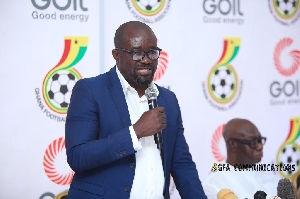

Kurt Okraku, the second vice president of the Confederation Africa Football (CAF), has disclosed that the executive council of the continental football governing body unanimously agreed to switch to a four-year Africa Cup of Nations cycle.
Before the commencement of the AFCON 2025 in Morocco, CAF president Patrice Motsepe announced that the AFCON tournament will move to a four-year cycle starting from 2028.
The decision has faced mixed reactions from pundits and football fanatics, with some taking a swipe at CAF for falling too low to the Europeans’ criticism of the tournament.
“We unanimously agreed to switch to a four-year AFCON cycle. The decision was driven by commercial considerations and the need to schedule the competition at a time that would not be worrying to the main actors (players). We also wanted to end clashes with our counterparts from other continents, particularly Europe,” he told Metro TV.
The AFCON has been staged every two years since 1968, with the only exception being a one-year gap between the 2012 and 2013 editions.
The current format will conclude with the 2027 tournament in Kenya, Uganda and Tanzania, after which the competition will transition to a four-year schedule starting in 2028. Motsepe also revealed plans to introduce an African Nations League, which is expected to be held annually from 2029.
The scheduling of AFCON has been a recurring challenge in recent years. The last three editions were rescheduled, with the 2021 tournament played in 2022 due to infrastructure delays in Cameroon, and the 2023 edition moved to early 2024 for similar reasons.
CAF had previously attempted to shift the tournament from its traditional January to February window to June and July, but only the 2019 edition in Egypt was held during that period, with extreme heat affecting performances.
The recently concluded 2025 Africa Cup of Nations saw Senegal defeating hosts, Morocco to annex the title for the second time in their history. The Atlas Lions hoped to end their 50-year trophy drought on home soil, but the Taranga Lions proved to be a stronger opponent.
Besides, the Super Eagles of Nigeria triumphed over Egypt in the third-place clash to secure the bronze medal at the tournament, held in the North African country.


