


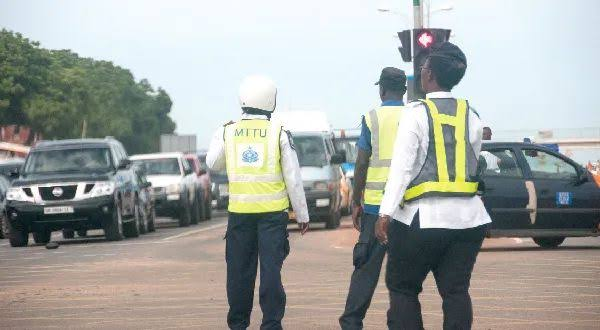
Director of Education, Research and Training at the Police Motor Traffic and Transport Department (MTTD), ACP Alexander Kwaku Obeng, has clarified that the introduction of a technology-driven traffic enforcement system, TraffiTech-GH, does not mean the police will disappear from the roads.
According to him, police officers will continue to be physically present on the roads to manage traffic, respond to road crashes and deal with situations that require direct human intervention.
Speaking on the Joy FM Super Morning Show on Wednesday, August 26, ACP Obeng said the use of cameras was intended to complement, rather than replace, conventional police work.
Responding to a question about whether the introduction of automated traffic enforcement would affect police visibility on the roads, he said, “It doesn’t necessarily mean that police physical presence will not be there.”
ACP Obeng explained that police visibility would remain necessary because there were several situations that could not be effectively handled by cameras or other digital tools.
“Visibility will be there, first of all, even in the case that there are certain instances that we need police to be controlling the traffic,” he said.
He added that officers would still be required to respond quickly to road crashes, manage traffic around accident scenes and ensure that injured people received assistance.
“Even in the case that when accidents occur, police officers have to be quickly deployed to ensure that roads will be managed,” he said.
“Persons who are injured are being attended to. Those who have suffered brutality are being referred, among others,” ACP Obeng added.
He said that certain provisions under the road traffic laws would also continue to require the physical presence of police officers.
According to him, police officers would also remain available to assist members of the public and deal with situations where roads are deliberately obstructed or used inappropriately.
“Is it not the case that people may obstruct the road and do all manner of things? So, policing will be sustained,” he said.
ACP Obeng, however, said digital enforcement would reduce the need for police officers to physically stop motorists for certain traffic offences.
He explained that technology could allow the police to gather evidence of traffic violations and engage vehicle owners or drivers without necessarily stopping them on the road.
“But issues regarding gathering evidence that normally will require arrest, impound, let’s go to a police station, and the convenience and all that, it is easy for us now to use digital tools, simple technologies, and software applications that will run on it for us to interface with the person who owns or who is driving without necessarily stopping or taking them to the police station,” he added.
ACP Obeng said the digital system was being introduced as part of a broader effort to create a safer and more resilient road environment.
“We are bringing it alongside, in the hope that in the future, we will have a more resilient road environment where digital tools will assist police,” he said.
He said the system could also encourage motorists to become more conscious of their behaviour, particularly when they know that traffic violations can be detected even when an officer is not physically present.
ACP Obeng said the ultimate objective was to prevent avoidable traffic offences and the crashes, deaths and injuries associated with them.
“I think police are there, day and night. So that people will be safe from committing certain preventable infractions that are exposing many of our compatriots and citizens to danger that are leading to preventable crashes, associated deaths, and injuries,” he said.
ACP Obeng also pointed to the number of traffic offences that could be covered by the enforcement system.
He said Parliament had permitted about 49 offences to be dealt with under the relevant framework, with additional motor-related infractions bringing the number to about 79 under Regulation 174.
“So I’m not surprised Parliament permitted about 49. And if you add the motor infractions, about 79 under Regulation 174,” he said.
According to him, the expanded enforcement framework would help protect road users, including motorists and users of two-, three- and four-wheeled vehicles.
He said the growing use of technology in traffic enforcement should ultimately make motorists more conscious of the responsibility that comes with using public roads.
“So that we’ll be able to protect many of our citizens who are permitted to come onto the road space to drive either two wheelers, three wheelers, four wheelers, and many of the vehicles that are running on multiple axles,” he said.
“So that as the roads are being opened up, drivers will be conscious that they are driving for life,” he added.
The TraffiTech-GH has been introduced to identify, track and penalise motorists who violate road traffic regulations.
TraffiTech-GH is an automated traffic enforcement system developed by the Ghana Police Service to monitor road use and improve road safety.
The system uses fixed intersection cameras, mobile vehicle-mounted cameras, handheld and tripod devices, as well as other digital monitoring tools to capture traffic offences.
DISCLAIMER: The Views, Comments, Opinions, Contributions and Statements made by Readers and Contributors on this platform do not necessarily represent the views or policy of Multimedia Group Limited.
DISCLAIMER: The Views, Comments, Opinions, Contributions and Statements made by Readers and Contributors on this platform do not necessarily represent the views or policy of Multimedia Group Limited.
Source link
