


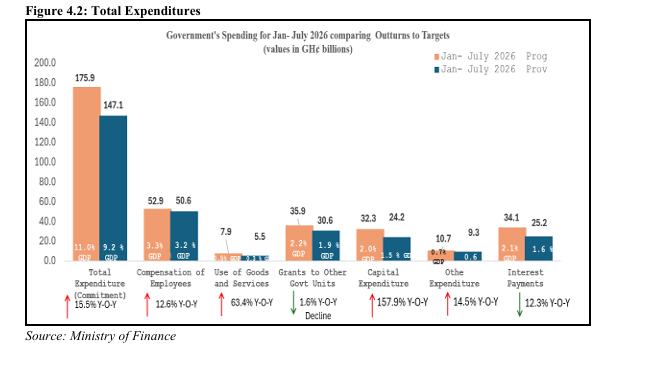
The government spent less in the first seven months of 2026, as Total Expenditures and Net Lending totaled GH¢147.077 billion in July 2026.
This was below the target of GH¢175.931.9 million by 16.4%.
According to the July 2026 Monetary Policy Report, Compensation of Employees amounted to GH¢50.553 billion, lower than the target of GH¢52.943 billion.
This outturn was below its target by 4.5% but recorded a 12.6% year-on-year growth.
The compensation budget of government employees constituted 35.2% of domestic revenue mobilised during the period under review.
The Use of Goods and Services totalled GH¢5.482 billion, lower than the expected target of GH¢7.897 billion. This outturn represented a year-on-year growth of 63.4%.
Total Interest Payments amounted to GH¢25.171 billion against the budget target of GH¢34.117 billion and 12.3% below the outturn of GH¢28.686 billion recorded in the corresponding period of 2025.
The reduction in interest payments was mainly on account of lower domestic interest payments as well as front loading of some Eurobond payments made at the end of 2025 which were originally programmed for 2026.
Grants to Other Government Units amounted to GH¢30.611 billion, lower than the target of GH¢35.866 billion. This outturn represented a year-on-year decline of 1.6%.
The Capital Expenditure amounted to GH¢24.228 billion (1.5% of Gross Domestic Product). This is lower than the programmed target by 25%.
This outturn represented a year-on-year growth of 157.9%.
Other Expenditure amounted to GH¢9.283 billion, 13.4% below the target. This outturn compared with GH¢8,107 billion recorded in the corresponding period of 2025.

Factors Behind Expenditure Performance
The report said the improved macroeconomic conditions had a positive knock-on impact on total interest payments.
Again, the relative stability of the Ghana cedi also reduced external interest costs.
The external interest payments also fell due to the front-loading of some payments made at the end of 2025 that were originally programmed for 2026.
In addition, the government benefited from reduced Eurobond debt servicing and concessional refinancing arrangements.
The reduction in goods and services stemmed from the containment of administrative spending, demonstrating the government’s continued focus on efficiency and value-for money across MDAs.
“Other expenditure” also fell, reflecting continued progress in rationalising energy-related obligations and improving efficiency in sector financing.
The fall in capital expenditure was due to the operationalisation of the commitment authorisation policy as stipulated in the PFM Act where payments for completed projects are only made on submission of invoices by contractors.
DISCLAIMER: The Views, Comments, Opinions, Contributions and Statements made by Readers and Contributors on this platform do not necessarily represent the views or policy of Multimedia Group Limited.
DISCLAIMER: The Views, Comments, Opinions, Contributions and Statements made by Readers and Contributors on this platform do not necessarily represent the views or policy of Multimedia Group Limited.
Source link


