


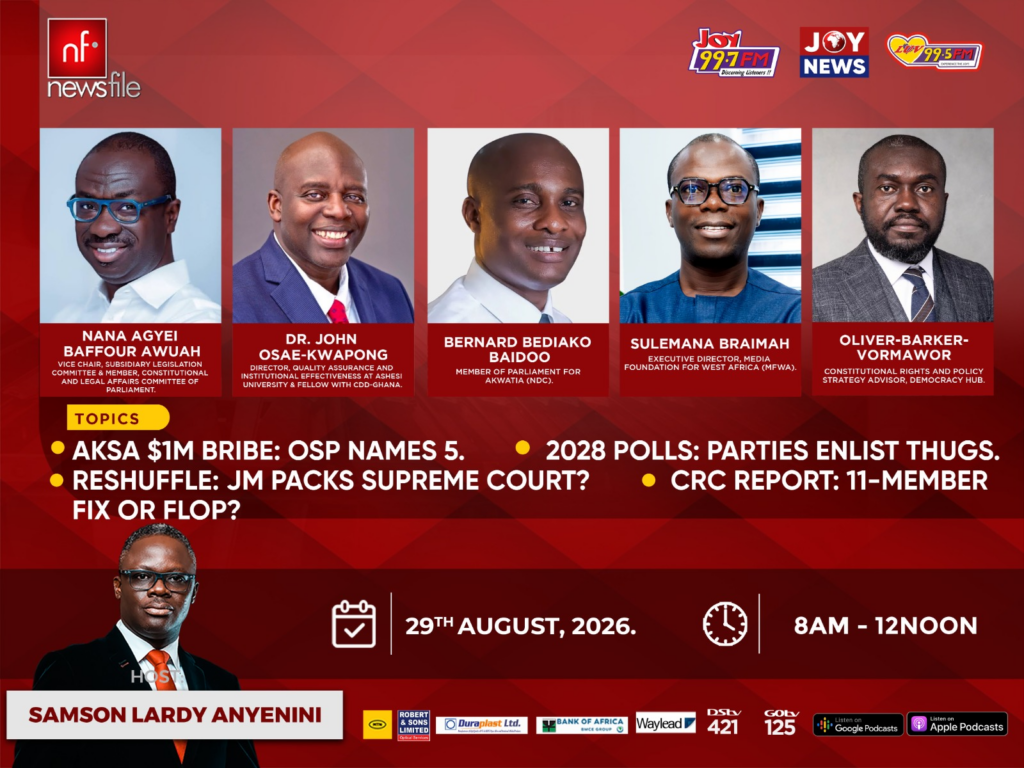
This Saturday on Newsfile, Ghana’s fight against corruption, the safety of the 2028 elections, changes in President Mahama’s government and the future of the country’s constitutional order come under intense scrutiny.
The Aksa power deal bribery investigation has taken a fresh turn, with the Office of the Special Prosecutor naming former Power Minister Dr Kwabena Donkor and others as persons of interest following the US prosecution of former TOR boss Asante Berko over an alleged one-million-dollar bribery scheme.
Dr Donkor has denied wrongdoing, but the investigation now brings the Ghanaian side of the controversial power transaction into sharper focus. What exactly happened in the Aksa deal?
Who allegedly received or facilitated the money? Did Ghana suffer any financial loss? And can the OSP turn the allegations emerging from the US case into a successful prosecution in Ghana?
As the country looks towards the 2028 elections, National Security is raising the alarm over what it describes as the changing face of political vigilantism.
Security officials say political groups are becoming more organised, operating underground and potentially preparing for electoral violence. Yet Ghana already has a law criminalising political vigilantism.
So why does the threat persist? Are political parties genuinely dismantling their vigilante structures, or are the groups simply operating under different names? And with 2028 still ahead, will the security agencies and political parties act early enough to prevent intimidation, violence and the undermining of Ghana’s democratic process?
Then, President Mahama has made fresh changes to his government, reassigning Labour Minister Abdul-Rashid Pelpuo and Deputy Defence Minister Ernest Brogya Genfi among others. Is this simply an administrative adjustment, or does the reshuffle signal dissatisfaction with performance and a strategic attempt to reposition government?
What should Ghanaians expect from the new assignments, and more importantly, how should we measure whether these changes actually improve delivery of the government’s reset agenda?

And now the Constitution Review process enters a new phase. Government has inaugurated an 11-member committee to begin working on the implementation of recommendations from the Constitution Review Committee. But constitutional reform is ultimately about more than reports and committees.
Which recommendations will President Mahama’s government accept? Which will it reject? Will politically sensitive proposals on elections, political parties, decentralisation and governance survive the implementation process?
And with the Supreme Court recently declaring the delegate system of political-party elections unconstitutional, is Ghana finally confronting some of the structural weaknesses in its democracy?
Four issues, but one fundamental question: are Ghana’s institutions strong enough to hold power accountable, protect our democracy and deliver the constitutional reforms the country needs?
This Saturday on Newsfile, we follow the money, interrogate the politics, examine the security threats and ask the difficult constitutional questions.
Join Samson Lardy Anyenini and his panel this Saturday at 8 a.m. on JoyNews and MyJoyOnline for the facts, the arguments, and the questions Ghana must confront.
If it’s Saturday, it’s Newsfile.
DISCLAIMER: The Views, Comments, Opinions, Contributions and Statements made by Readers and Contributors on this platform do not necessarily represent the views or policy of Multimedia Group Limited.
DISCLAIMER: The Views, Comments, Opinions, Contributions and Statements made by Readers and Contributors on this platform do not necessarily represent the views or policy of Multimedia Group Limited.
Source link


