


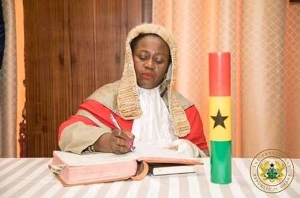
 Chief Justice Gertrude Torkornoo
A renowned legal practitioner, Tsatsu Tsikata, has expressed his concerns about the loss of confidence in Ghana’s judiciary.
A recent report released by the Mo Ibrahim Foundation showed a substantial decline of about 30% in the alleged impartiality of Ghana’s judiciary between 2017 and 2023. The report’s indicator assesses judicial impartiality based on factors such as the independence of the courts, the autonomy of judges, and judicial appointments.
The National Security Minister, Albert Kan Dapaah, after the report was released, warned that the perception that the judiciary is biased has terrible consequences for the country’s security.
According to him, citizens may be forced to take the law into their own hands for personal satisfaction if the bench is believed to be unfair.
Speaking in an interview on GHOne TV with Serwaa Amihere, Tsatsu Tsikata expressed his worry about the weakening of public trust in the judicial system.
“If people lose confidence in the judiciary, it is also a loss of confidence in the legal profession,” he explained.
“The judiciary is made up of individuals who have risen through the ranks of the legal profession, and when confidence in the judiciary wanes, it directly impacts the entire process of adjudication, which is what lawyers practice in the court,” he added.
The senior legal practitioner further emphasized the implications for the country, particularly following recent statements made by the National Security Minister in addressing the judges, pointing out that the judiciary’s decisions are perceived as favoring the New Patriotic Party (NPP).
“You could put it in very diplomatic terms, but the message is clear: there’s a perception that the judiciary is acting in favor of the NPP,” he said.
Adding that, “There is a growing pattern where ordinary citizens jokingly refer to the judiciary as a ‘unanimous football club,’ deciding cases in favor of one side. This creates a dangerous precedent where people lose faith in the judicial process altogether,” he said.
He warned that this perception could have serious consequences for the credibility of the judicial system.
