



Ghana’s turbulent revolutionary period of 1979 reached its most dramatic and controversial turning point when the Armed Forces Revolutionary Council (AFRC), led by Flt Lt Jerry John Rawlings, ordered the execution of several senior military officers, including three former heads of state.
The executions, carried out in June 1979, following military tribunals, were officially justified as a decisive response to corruption, economic mismanagement, and the abuse of state power that had plunged the country into severe hardship.
Ex-Sergeant Peter Tasiri, ‘the main brain behind the June 4 Uprising’, is dead
Following the June 4 uprising, the AFRC established special tribunals composed largely of junior-ranked military personnel to prosecute individuals accused of contributing to Ghana’s economic decline.
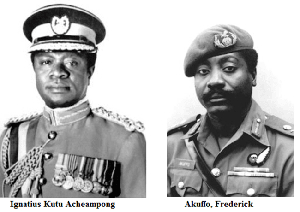
Among those tried were three former heads of state: Ignatius Kutu Acheampong, Fred Akuffo, and Akwasi Afrifa.
According to a documentary by Bisimedia on YouTube, the men were accused of enriching themselves while in office and dissipating state resources at the expense of ordinary citizens.
The AFRC maintained that no individual, regardless of rank or past leadership, would be shielded from accountability.
On June 16, 1979, Ghanaians woke up to the shocking announcement that Acheampong, together with Major General EK Utuka, a former Border Guards Commander, had been executed by firing squad after being found guilty of capital offenses.
The announcement sent shockwaves across the country, marking an unprecedented moment in Ghana’s history; the execution of a former head of state by a revolutionary military regime.
Ten days later, on June 26, 1979, the AFRC carried out further executions at dawn in Accra.
Among those executed were Akuffo and Afrifa, alongside several top-ranking military commanders of the previous regime.
In total, eight senior officers were executed during the revolutionary purge, an action the AFRC described as a necessary “house-cleaning” exercise aimed at restoring integrity, discipline, and public confidence in governance.
The revolutionary government insisted the executions were intended to serve as a deterrent against corruption and abuse of power, framing them as part of a broader effort to reset Ghana’s political direction.
However, the events remain one of the most debated chapters in the country’s history, viewed by some as revolutionary justice and by others as an episode of irreversible national trauma.
The real story behind the June 4 Revolution: Separating the facts from fiction
Decades later, Jerry John Rawlings acknowledged that some individuals executed during the period may not have borne full responsibility, but he maintained that the actions were taken within the context of what he described as a moral and political struggle for Ghana’s future.
MAG/AE
Watch as Dr Bawumia, Bola Ray pay tribute to late Alhaji Sidick:


