


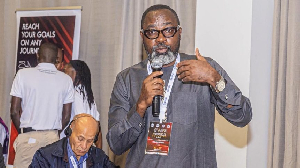
 Secretary-General of the Sports Writers Association of Ghana (SWAG), Charles Osei Asibey
The Secretary-General of the Sports Writers Association of Ghana (SWAG), Charles Osei Asibey, has called for a radical shift in the media’s approach to women’s sports.
Speaking at the Sir Dawda Kairaba Jawara International Conference Centre, Osei Asibey underscored that the lack of visibility for female athletes remains a systemic failure within the African press.
He urged journalists to move beyond traditional biases and help women’s sports attain the same level of prestige and commercial viability as men’s sports.
Osei Asibey also highlighted the proactive steps taken by SWAG to lead by example, noting that the association has three women on its executive body and has successfully integrated women into its core ranks.
Currently, 15 per cent of SWAG’s membership is female—a figure the association is actively working to increase. By creating a formal space for women within the organisation, SWAG aims to build a foundation where female voices are not only present but influential in shaping the narrative of Ghanaian and African sports.
However, “The Barrister,” as he is affectionately known, was candid about the steep hurdles that remain.
He identified religion as a major barrier, particularly in regions where traditional beliefs may inadvertently discourage women from pursuing careers in the public eye or participating in sports culture.
hese deeply rooted social norms, he said, often create an invisible ceiling that prevents talented women from even entering the press box.
Osei Asibey further expanded on the role of education as a double-edged sword. While it is key to professional growth, the lack of specialised training in sports journalism for women has historically left them at a disadvantage.
Without targeted educational initiatives and mentorship programmes, the gap between male and female sports writers will continue to widen, making it harder for women to claim their rightful place in the industry.
Central to his argument was the issue of self-confidence. Osei Asibey noted that the male-dominated nature of sports newsrooms often erodes the confidence of aspiring female journalists.
This psychological barrier prevents many from asserting themselves in high-pressure environments, such as covering major tournaments or interviewing top-tier athletes, leading to a cycle of exclusion that is difficult to break without institutional support.
He also raised a particularly poignant concern about a paradox within the profession—women journalists not covering women’s sports.
Osei Asibey observed that even when women enter the profession, they often gravitate towards covering male-dominated sports or high-profile male athletes in a bid to gain professional “legitimacy.”
This trend further marginalises women’s sports, as the very people best positioned to offer nuanced perspectives are looking elsewhere.
He challenged female sports writers to take ownership of women’s sports. By choosing to cover female athletes, women journalists can provide the depth and empathy required to tell these stories authentically.
This “internal” lack of coverage by female peers, he noted, remains a major bottleneck preventing women’s sports from achieving the same level of prestige and commercial viability as men’s sports.
The Secretary-General also urged media houses across the continent to implement policies that incentivise the coverage of women’s sports and individual female stars.
He argued that the growth of Africa’s sports industry is inextricably linked to how society treats the “other half” of the population, stressing that without a deliberate editorial focus on women, the African sports narrative remains incomplete and economically undervalued.
