


The Ministry of Education has issued a clarification on the Government’s proposed language of instruction policy for basic schools, seeking to dispel widespread misconceptions and reassure the public that foreign languages have not been made compulsory under the revised curriculum.
The clarification follows intense public discussion and speculation over proposed changes to the country’s education system, with some reports incorrectly suggesting that pupils would be required to study foreign languages such as French, Arabic and Chinese from the early years of schooling.
In a statement, the Ministry stressed that the revised language policy is designed to improve literacy, learning outcomes and cognitive development by ensuring that children begin their education in a language they understand best before gradually transitioning to English.
According to the Ministry, Ghanaian languages will become the principal medium of instruction from Kindergarten (KG) to Primary Three under the proposed revised curriculum.
Education authorities explained that the approach is intended to strengthen children’s foundational literacy and numeracy skills while promoting critical thinking and overall cognitive development during their formative years.
The Ministry noted that research conducted across the world consistently demonstrates that children achieve better educational outcomes when they are taught in a familiar language during the early stages of their education.
Learning in a language they already understand enables pupils to grasp concepts more quickly, participate confidently in classroom activities and develop stronger communication skills.
Officials believe the policy will lay a stronger educational foundation for pupils while reinforcing Ghana’s rich linguistic and cultural identity.
The revised curriculum proposes a gradual transition beginning in Primary Four, when both Ghanaian languages and English will be used as the medium of instruction until Primary Six.
The Ministry said the bilingual model is intended to ensure pupils are adequately prepared for higher levels of education, where English increasingly becomes the dominant language of instruction.
At the same time, maintaining Ghanaian languages alongside English is expected to preserve learners’ proficiency in their mother tongues, encourage multilingualism and prevent the gradual erosion of indigenous languages.
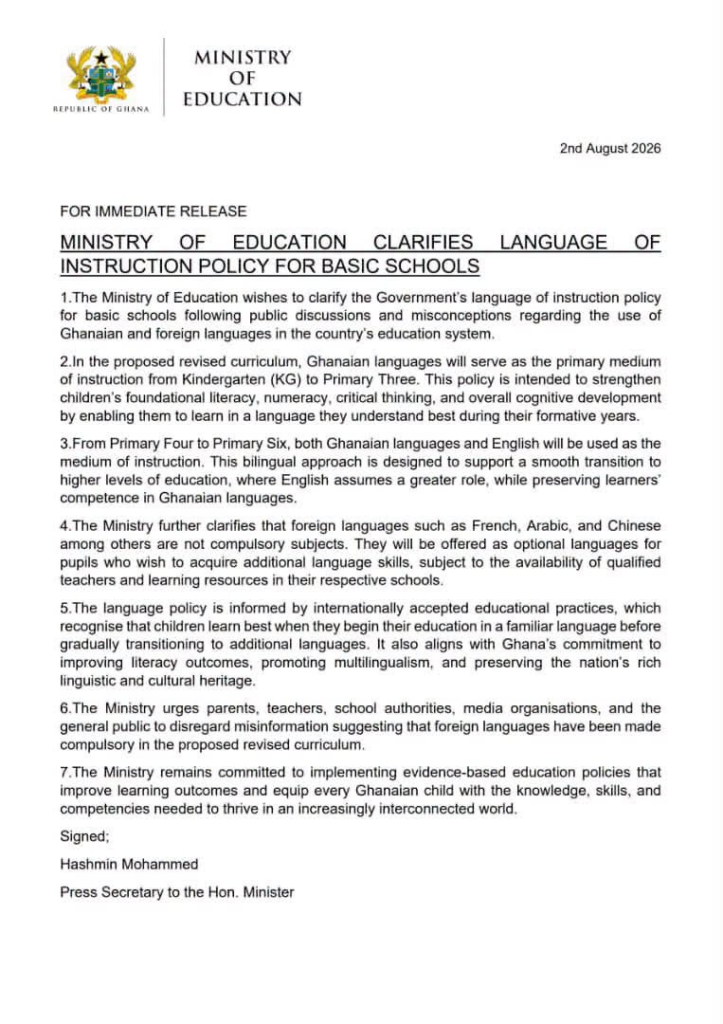
Addressing one of the most debated aspects of the proposed curriculum, the Ministry categorically stated that foreign languages—including French, Arabic and Chinese—will remain optional rather than compulsory subjects.
It explained that these languages will only be offered to pupils who wish to acquire additional language skills and where schools have the necessary teaching staff and learning resources.
The Ministry therefore dismissed claims circulating on social media and other platforms that every pupil would be required to study one or more foreign languages under the revised curriculum.
Officials urged the public to rely on official government communication rather than unverified reports regarding education reforms.
The Ministry said the revised language policy is informed by internationally recognised educational principles, which recommend that children begin learning in their first language before gradually acquiring additional languages.
Research by educational institutions and international organisations has consistently shown that early instruction in a familiar language improves literacy, comprehension, classroom participation and long-term academic performance.
The Ministry said the policy also aligns with Ghana’s broader educational objectives of improving literacy standards, promoting multilingual education and preserving the country’s diverse linguistic and cultural heritage.
By encouraging competence in both Ghanaian languages and English, the Government aims to produce learners who are academically equipped while remaining connected to their cultural roots.
The Ministry called on parents, teachers, school administrators, media organisations and the general public to disregard misinformation surrounding the proposed curriculum.
It reiterated that reports claiming foreign languages have been made compulsory are false and do not reflect the Government’s education policy.
Officials encouraged all stakeholders to seek clarification through official Ministry channels before drawing conclusions about proposed reforms.
Reaffirming its commitment to strengthening Ghana’s education system, the Ministry said it remains focused on implementing evidence-based policies that improve teaching and learning across the country.
DISCLAIMER: The Views, Comments, Opinions, Contributions and Statements made by Readers and Contributors on this platform do not necessarily represent the views or policy of Multimedia Group Limited.
DISCLAIMER: The Views, Comments, Opinions, Contributions and Statements made by Readers and Contributors on this platform do not necessarily represent the views or policy of Multimedia Group Limited.
Source link
