


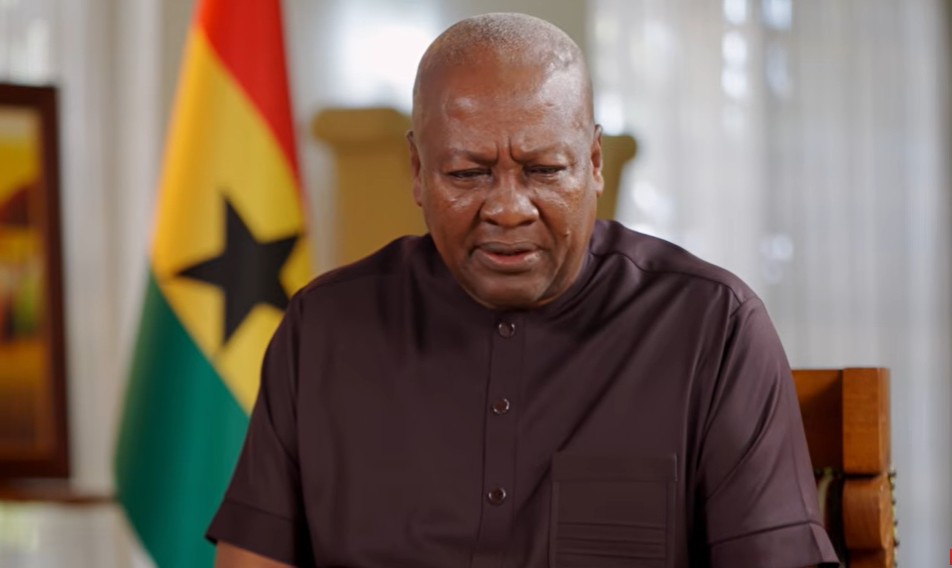
President John Dramani Mahama has expressed disappointment with the decision by the United States to vote against a landmark United Nations resolution recognising the transatlantic trafficking of enslaved Africans and racialised chattel enslavement as the gravest crime against humanity.
Speaking in an interview with TRT World on Friday, August 21, President Mahama said he had not expected the United States to oppose the resolution because, in his view, the country should not be regarded as the principal party responsible for the transatlantic slave trade.
“I was disappointed that they did because I don’t hold the US accountable for slavery,” he said.
According to the President, most of the enslaved Africans taken to what became the United States were transported there by European powers at a time when the United States itself was still a colony.
He, however, acknowledged that slavery continued in the United States after independence and was only abolished following the Civil War.
“Even though after the abolition and after the United States became an independent country, slavery continued until the Civil War was fought and that eventually freed the slaves in the US,” he said.
President Mahama said that while the United States derived significant economic benefits from slavery, including infrastructure development, he did not believe the country should bear the same historical responsibility for the transatlantic slave trade as the European powers that organised and facilitated the trafficking of Africans to the Americas.
“I don’t think that they should bear the guilt, in a certain sense, for it because I would have thought that the European countries that brought the slaves there would feel more adverse to the resolution,” he said.
He said he was therefore concerned that the United States voted against the resolution while European countries with direct historical links to the slave trade chose to abstain.
“Even they abstained,” he noted.
The comments come months after Ghana secured a historic victory at the UN General Assembly when 123 countries voted in favour of the resolution on March 25, 2026. The United States, Israel and Argentina voted against it, while 52 countries, including Britain and European Union member states, abstained.
The resolution, spearheaded by President Mahama in his capacity as the African Union Champion for advancing justice and the payment of reparations, also calls for good-faith dialogue on reparatory justice and the restitution of cultural property. It is not legally binding but carries significant political and moral weight.
The vote represented a major milestone in Ghana’s campaign to place reparatory justice for slavery and its enduring consequences at the centre of the international agenda.
The transatlantic slave trade forcibly removed millions of Africans from the continent between the 15th and 19th centuries, with the effects of enslavement continuing to shape debates on racial inequality, economic disparities, historical justice and restitution.
President Mahama has maintained that the reparations campaign is not intended simply to reopen historical wounds but to promote truth, healing, reconciliation and practical measures to address the enduring consequences of slavery.
At a high-level consultative conference in Accra in June, he said the pursuit of reparatory justice should move beyond resolutions towards concrete action.
The European Union, in explaining its abstention at the UN vote, said it condemned the slave trade but had concerns about the resolution’s legal formulations, including claims for reparations and the application of international law to historical events.
Ghana’s reparations campaign is expected to remain a major component of the country’s international diplomacy as the government works with African and diaspora partners to translate the UN resolution into practical measures for reparatory justice.
DISCLAIMER: The Views, Comments, Opinions, Contributions and Statements made by Readers and Contributors on this platform do not necessarily represent the views or policy of Multimedia Group Limited.
DISCLAIMER: The Views, Comments, Opinions, Contributions and Statements made by Readers and Contributors on this platform do not necessarily represent the views or policy of Multimedia Group Limited.
Source link
