


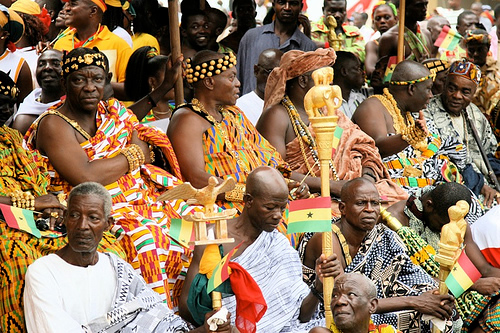
By Kwasi Ansu-Kyeremeh, The Chieftaincy Institute
Chieftaincy’s natural power and capacity to lead local development have been grossly underrated and it is time to address that constitutionally. For accelerated local development, there is an urgent need to reverse the constitutional usurpation of that local development role which it assigns to local government.
Article 245(a) of Ghana’s 1992 Constitution mandates a decentralised system of local government and administration to drive local development. So far, the article has underperformed in implementation, such that the Constitution Review Committee (CRC) seeks its review in an “all development is local” approach.
To fix the local development deficit, CRC recommends “introduce direct elections for local government chief executives (MMDCEs),” instead of currently being appointed; together with the establishment of an Independent Devolution Commission (IDC) to intensify decentralisation and invigorate local development authority.
That sets a task for the Constitution Review Implementation Committee (CRIC) to enact constitutional intervention to remedy the little development at the local level which tends to slow national development. For that transformative local governance for accelerated local development, chieftaincy (as in occupiers of skins and stools), stands ready for consideration by CRIC as the logical apparatus. Even so, item 12 (electing MMDCEs) of the 13 points of action by CRIC seems far less capable of addressing that task of an article of local empowerment for local development as “fapem” (bedrock) of national development
Yet, dare one mention chieftaincy as the more viable agency for accelerated local development, and an initial reaction will likely be that it is too dividing and less uniting over succession issues to champion development. Fact, though, is that the negative of chieftaincy as source of conflict is overblown, while the institution’s massive potential as agent for local development, is woefully underrated.
A constitution is made to last, but it must first tackle the now issues. They say “72% of Ghanaian youth have considered leaving the country” for lack of employment opportunity. Tertiary students and graduates are actively involved in galamsey. The National Development Planning Commission (NDPC) attributes the syndrome of abandoned projects to “political discontinuity” and “lack of legal enforcement.” And despite legislation, public procurement abuse is widespread. As macro issues that they might be, they have implications for local development.
Historically, though, Biadanhene (chief) Nana Kwasi Ansu in the Berekum Traditional Area led his people to provide themselves with real development. Within two short years in the 1950s, the chiefdom provided itself with pipe-borne water and a community centre with day nursery annexed building complex. A farm trail was upgraded to a motorable road; and a generating plant was procured to supply electricity. Such micro activity can serve as the foundation for national development.
These days, from the village head (adikrofoɔ) through subchiefs (abrempɔn) to paramount chiefs (amanhene) all the way to the Asantehene, chiefs are still able to utilise their paltry traditionally decentralised authority to develop their areas. They mobilise to provide health and education facilities, social amenities and infrastructure to stimulate economic activity for the development of their chiefdoms. Just imagine what chieftaincy can do with its authority boosted by the constitution.
Basically, chieftaincy is “democratic government to a degree of which there is not any modern parallel in Europe,” with decentralisation as “one of its outstanding characteristics.” It is centripetally bottom-up and, therefore, naturally sensitive to local development. Chieftaincy democracy develops where “election democracy” may not. Thus, the institution deserves the restoration of its authority to develop which is constitutionally usurped in local government with the 1992 Constitution.
At each level of the chieftaincy hierarchy, the leader/chief is sufficiently empowered and reseanobly resourced with the autonomy and power to mobilise at each level of the hierarchy to develop the jurisdiction/chiefdom; no dependence on the centre to decentralise/devolve/disburse authority or resources before initiating, planning and implementing local development.
Traditional leaders are more knowledgeable, have richer lived life experiences and, by that, better prepared as development leaders than the political class. The former are empowered and compelled by culture, tradition and customary practice to mobilise human and material (land) resources to improve the living conditions of their people. And the institution’s gender inclusive queenmother role strengthens the active participation of women in the thinking and doing of local development that leads to national development.
Among the tools available to the chief for the mobilisation and execution of a local development agenda are the network of vertical sub-authorities in subchiefs, courtiers and other chiefly actors and the horizontal abusua (family/clan) groups with defined heads. A chief also has the power to create nkɔsoɔ (development) and boafoɔ (helper) stool occupants to specifically spearhead development activity. Also at his disposal are devices such as the dawuro concept for effective communication. Some skins and stools own communication centres, radio stations, websites or are robustly present on various social media platforms.
Alternatively, whatever its strengths, the imported local government, as is practised now by Chapter 20 of the 1992 Constitution, is severely limited productively, satisfactorily and effectively as a replacement for chieftaincy in promoting development at the grassroots. Decentralised authority for the local to develop itself within the broader national context is endlessly pursued or it “has collapsed;” or “dysfunctional.” Others think it is “centralisation of decentralistion;” that the central government develops the underdevelopment of the local area.
With its built-in politics of ampɛbrɛ (shuns hard work), ammɔbra (unachieved), kakistocratic and kleptocratic tendencies, local government political actors are engaged in some kind of operation hide the loot, employing all schemes to evade asset tracking and lifestyle audit accountability. Indeed, chieftaincy’s organic dynamics surpasses the superficial workings of local government in linking the people to their life struggles.
What is missing in a development transformative role for chieftaincy is the constitutional mandate to develop as assigned to local governemnent in Article 245(a)(b) of the 1992 Constitution. With chieftaincy, if there are lapses in development thought and action, it is possibly due to development being voluntary and not being required by law.
A constitutionally reorganised Chief-in-Council (CiC) local governance system that incorporates the tappable elements of both chieftaincy and local government. It inherits chieftaincy’s already effectively decentralised structure and quality leadership that thinks and does great local development. A lead chief (rotational among peers) would preside over a council of elected and appointed on merit membership. Term limits are to be enforced and where there is only one senior chief, the next (set) in grade shall be promoted to occupy the position (by rotation).
Structurally, the CiC has the features of: 1) merged authority 2) enhanced resourcing 3) guaranteed tenure and, therefore, continuity of programmes and projects post-election changes, 4) accountability and transparency 5) effective monitoring and supervision 6) quality leadership in a combination of knowledge and lived life experience, not ampɛbrɛ and ammɔbra political appointees and 7) prospects for rapid industrialisation.
It is proposed for the consideration of the CRIC, that the CiC organ will be the constitutional replacement for the current dualised paralleling local governance system of chieftaincy and local government. Its structure also incorporates advisory committees which might co-opt outside expertise to enhance decision-making and implementation. A specialised standing committee on women and associated issues, is to be chaired by the queenmother. Committees will deliberate the affairs of the units for in-depth knowledge to guide policy formulation and implementation.
An administrator, appointed on merit, will run a bureaucracy organised into functional units. Each unit is to be headed by a person with technical knowledge of the area. Among unit responsibilities are to research, offer technical advice and help implement programmes and projects.
One envisages enhanced opportunity of increased economic activity with the chief in charge to push for rapid industrialisation and development of the people in local communities. With a key focus on job creation, the chief-led CiC may want to explore clues and cues from Nkrumah’s cottage industries, Busia’s rural industries, Kufuor’s presidential initiatives and Akufo-Addo’s one village one dam/one district one factory as they affected local industrialisation.
CONCLUSION
It is time the Constitution took advantage of our own indigenous institutions to define and pursue our common development destiny by constitutionally redirecting the effort and resources for improving the local government system towards strengthening the empowerment of the chieftaincy institution to deliver “all development is local,” especially by strengthening its leadership accountability mechanisms. For a meaningful impact on the lives of ordinary Ghanaians, any change in the constitution regarding local development must necessarily begin with the recognition of chieftaincy as the primary local development agency. It is the people, with leadership of occupants of skins and stools who combine sukuu nyansa (knowledge) and efie nyansa (wisdom) with rich life experiences. That makes the traditional leader better prepared for executing the local development task than the transient political actors of less connection to the people and less so equipped to lead to develop.
Chieftaincy is unable to vigorously pursue its development responsibility because the authority to do so is usurped by the constitutional local government. Presently, lapses in development thought and action partly because the chief’s development responsibility not mandatory but rather voluntary. Chieftaincy must be treated as transformable, constitutionally formulated as transformative development apparatus for the aggressive pursuit of an “all development is local” agenda. That must be the focus and product of a CRIC organised 12th of the13 points of constitutional review.
Otherwise, the huge costs of the review of the 1992 Constitution since 2010 would have effectively betrayed the people and failed the CRC’s cardinal recommendation of local development for, and as, national development. Lest we forget the grassroots chant the authors/originators of the 1992 Constitution have forgotten by grabbing USD1.7 billion gold heist: “Ghana people we are always fighting for our rights. We no go sit down make dɛm cheat us every day. Daabi da!!!” Just imagine a constitution that mandates chiefs as the main agency for the development of their chiefdoms. It will no longer be “their” intervention project or programme but us empowered to develop of us, for us, in us, by us, about us, and to us!!!
DISCLAIMER: The Views, Comments, Opinions, Contributions and Statements made by Readers and Contributors on this platform do not necessarily represent the views or policy of Multimedia Group Limited.
DISCLAIMER: The Views, Comments, Opinions, Contributions and Statements made by Readers and Contributors on this platform do not necessarily represent the views or policy of Multimedia Group Limited.
Source link


