


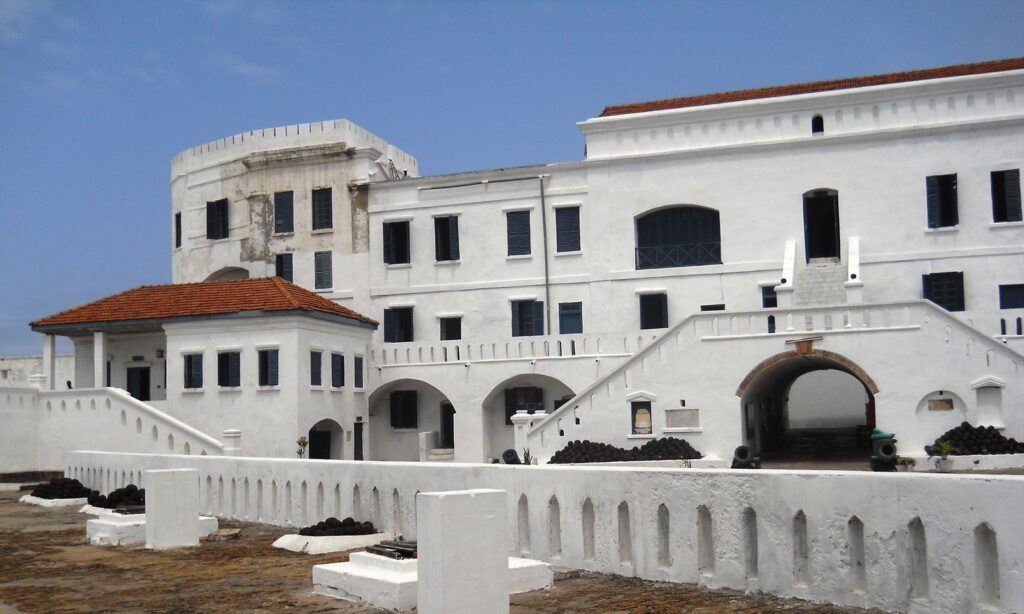
For decades, Ghana’s climate conversation has largely been framed around rising temperatures, erratic rainfall, flooding, coastal erosion, food security and the livelihoods of vulnerable communities.
But there is another dimension to the climate crisis that deserves far greater attention: what happens to the places and institutions through which a society remembers itself?
Ghana’s forts and castles are beginning to provide a sobering answer.
The government’s announcement of a $4.5 million Korea-Ghana Heritage Project to address the impact of climate change on Ghana’s forts and castles is therefore more than a conservation intervention. It is a recognition that climate change is becoming a threat to the country’s cultural memory.
The five-year project, which will run from 2026 to 2030, will initially focus on six heritage sites in the Greater Accra Region: Ussher Fort and James Fort in Jamestown, Christiansborg Castle in Osu, Fort Augustaborg in Teshie, Fort Vernon in Prampram and Fort Fredensborg in Old Ningo.
The sites face threats including coastal erosion, flooding, salt-induced deterioration, structural instability and extreme weather conditions.
These are not merely architectural problems. They are climate problems. And they are cultural problems.
A heritage site is more than bricks, stone and mortar. It is a physical record of a people’s history. It carries stories, memories, identities and experiences from one generation to another.
Ghana’s forts and castles occupy a particularly complicated place in that history. They represent some of the darkest chapters of the transatlantic slave trade and colonialism, but they are also important sites of memory, education, tourism and historical reflection.
Their preservation therefore matters beyond architecture. If climate change contributes to the deterioration or eventual loss of these sites, Ghana does not simply lose buildings. It risks losing physical spaces through which future generations can encounter and interrogate the past.
That is why the Korea-Ghana project deserves to be viewed through a much wider lens.
The project will establish scientific climate-risk assessment and monitoring systems, develop climate-response policies, strengthen institutional capacity, create integrated data and climate-risk mapping systems, and promote community participation.
These are exactly the kinds of interventions required when climate change moves from being a distant environmental concern to a direct threat to cultural assets.
The project also provides an important lesson for Ghana’s broader climate policy.
Climate adaptation cannot only be about protecting what sustains our bodies and economies. It must also be about protecting what sustains our collective memory.
The six forts and castles are only part of the story.
If climate change can threaten heritage sites, what does it mean for the wider cultural ecosystem? What happens to festivals when extreme rainfall disrupts events? What happens to outdoor concerts as heat becomes more intense? What happens to museums and archives when flooding, humidity and extreme temperatures threaten collections? What happens to traditional buildings and cultural landscapes exposed to increasingly unpredictable weather?
What happens to tourism destinations whose appeal depends on ecosystems, landscapes and heritage? And what happens to the creative businesses that depend on all of these spaces?
These questions are increasingly difficult to separate from climate policy.
Ghana’s cultural economy is built around physical places, natural resources, human creativity and communities. Climate change has the potential to disrupt every one of those foundations.
Yet conversations about climate change and conversations about culture often continue to happen in separate rooms.
Climate experts talk about adaptation. Cultural institutions talk about preservation.
Tourism authorities talk about destinations. Artists talk about creative expression.
Businesses talk about sustainability. Communities talk about livelihoods.
The reality is that these conversations are increasingly connected.
There is a tendency to view culture as something climate change threatens and therefore something that needs to be protected.
That is only half the story. Culture can also be part of the climate response.
Artists can translate complex climate science into stories people understand. Filmmakers can document disappearing landscapes and vulnerable communities.
Musicians can take climate messages to audiences that traditional policy communication may never reach.
Fashion designers can rethink materials, production and consumption. Architects can combine cultural identity with climate-resilient design.
Content creators can make climate issues relevant to younger audiences. Museums and heritage institutions can become spaces for climate education.
Tourism operators can develop more resilient and sustainable models. And festivals can become platforms for demonstrating sustainable approaches to energy, mobility, waste and consumption.
This is where the climate conversation begins to look very different. Culture is not simply a casualty of climate change. It is also an asset for climate action.
Ghana’s creative economy is increasingly important to the country’s economic and social development.
But if the sector is to grow sustainably, it must also confront the environmental realities shaping its future.
The question is no longer simply whether an event, concert, film production or festival is commercially successful.
We must also begin asking: How much waste does it generate? Where does its energy come from? How resilient is its infrastructure? How much does transportation contribute to its environmental footprint? Can creative businesses access financing to adopt sustainable practices?
Can climate-conscious production become a competitive advantage?
And can Ghana develop a creative economy that does not simply generate cultural and economic value, but also contributes to climate resilience?
These questions require collaboration between people who traditionally have not occupied the same policy spaces.
Climate scientists need creatives. Cultural institutions need technologists.
Tourism operators need environmental experts. Artists need climate information.
Governments need the creative sector. And communities need to be at the centre of the conversation.
From protecting heritage to building climate resilience
The Korea-Ghana Heritage Project offers an important starting point.
Its emphasis on climate-risk assessment, mapping, monitoring, policy development, institutional capacity and community engagement demonstrates what a serious climate-and-culture intervention can look like.
But Ghana should not stop at protecting six heritage sites.
The bigger opportunity is to develop a national framework for climate-resilient culture and a sustainable creative economy.
That framework could bring together heritage conservation, tourism, creative industries, sustainable events, waste management, renewable energy, climate finance, technology and climate communication.
It could also create opportunities for young people and creative professionals to participate in the country’s climate response—not merely as campaigners, but as entrepreneurs, innovators, storytellers and solution providers.
The question should therefore not only be: How do we save our forts and castles from climate change?
It should also be:
How do we build a cultural economy capable of surviving and helping society respond to the climate crisis?
Ghana needs a Climate x Culture conversation
The $4.5 million Korea-Ghana project is an important reminder that climate change is already affecting Ghana’s cultural heritage.
But perhaps its greatest value will be if it forces us to ask a much bigger question.
What if climate policy and cultural policy were no longer treated as separate conversations?
What if the people designing climate adaptation strategies routinely worked with artists, heritage professionals, filmmakers, musicians, fashion designers, tourism operators, architects, content creators and creative entrepreneurs?
What if culture was recognised not simply as something that needs to be protected from climate change, but as one of the tools through which societies can understand, communicate and respond to it?
Ghana’s forts and castles are warning us that the climate crisis is not only about what happens to our environment.
It is also about what happens to our identity, our stories, our creative economy and our memory.
The challenge now is to listen to that warning and broaden the climate conversation accordingly.
It is against this backdrop that the Climate x Culture Summit, organised by CultureJoint, on October 22, 2026, will bring together policymakers, climate experts, cultural and heritage institutions, creative professionals, artists, tourism stakeholders, content creators and young leaders to examine the intersection between climate action and culture.
Under the theme “Climate x Culture: Designing sustainable experiences for Africa,” the Summit to be held at the Google AI Centre in Accra will explore how Africa’s creative and cultural sectors can respond to climate change while unlocking opportunities in sustainable tourism, heritage preservation, green creative businesses, sustainable events, climate finance, renewable energy, waste management and climate storytelling.
Climate and culture can no longer afford to exist in separate rooms.
DISCLAIMER: The Views, Comments, Opinions, Contributions and Statements made by Readers and Contributors on this platform do not necessarily represent the views or policy of Multimedia Group Limited.
DISCLAIMER: The Views, Comments, Opinions, Contributions and Statements made by Readers and Contributors on this platform do not necessarily represent the views or policy of Multimedia Group Limited.
Source link
