


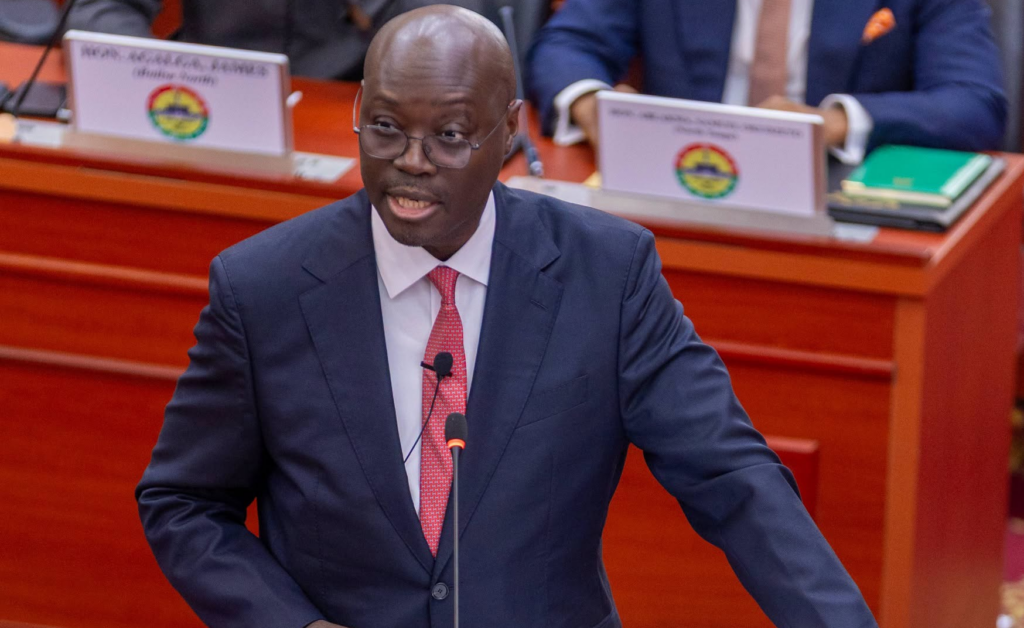
Dr Cassiel Ato Forson, Finance Minister.
Finance Minister Dr Cassiel Ato Forson says Ghana must reshape its economy to support 35 million people and create decent jobs, rather than rely on temporary employment programmes.
Speaking in an interview on Thursday after presenting the 2027 Budget to Parliament, he argued that the country’s economic structure had not kept pace with its population.
“We are 35 million people and counting.”
Dr Forson said an economy designed for a much smaller population could not adequately meet today’s employment needs without fundamental changes.
He described the government’s New Economy policy as an effort to address that mismatch through structural reform and modernisation.
“The focus of this new economic policy is to tackle the structure of the Ghanaian economy, to modernise it into a modern economy, to be able to support 35 million people, and not 6 million people.”
The minister argued that temporary employment schemes could not replace an economy that generates sustainable opportunities.
Referring to NABCO and Youth Employment Agency models, he said such interventions did not resolve the underlying problem.
“They are temporary jobs.”
For Dr Forson, the next phase of economic policy must therefore go beyond stabilising headline indicators. It must strengthen the economy’s capacity to absorb people into decent employment.
“What again can we do beyond macroeconomics to tackle the structure of the economy?”
He said the government’s immediate priority after taking office in 2025 had been to restore fiscal discipline and prevent a deeper crisis.
According to him, persistent inflation and disorder in public financial management required difficult decisions to constrain spending.
“There was a lot of disorder; we brought order to the public financial management system.”
He attributed the subsequent currency stability and primary surpluses to those measures.
Dr Forson cited a primary surplus of 2.5% of Gross Domestic Product in 2025 and 1.5% in 2026 as evidence of the fiscal adjustment.
He said the government now intended to lower the target as it pursued the next stage of its economic programme.
“Now I need to reduce the primary surplus from 1.5% of GDP to 0.5%.”
The minister maintained that structural transformation must proceed alongside continued discipline. His central argument was that restoring stability created the opportunity to tackle deeper weaknesses that limit employment and economic opportunity.
DISCLAIMER: The Views, Comments, Opinions, Contributions and Statements made by Readers and Contributors on this platform do not necessarily represent the views or policy of Multimedia Group Limited.
DISCLAIMER: The Views, Comments, Opinions, Contributions and Statements made by Readers and Contributors on this platform do not necessarily represent the views or policy of Multimedia Group Limited.
Source link


