


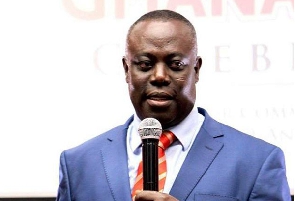

Former President of the Ghana Pentecostal and Charismatic Council (GPCC), Rev Professor Paul Frimpong-Manso has said that illegal small-scale mining (galamsey) is a moral and spiritual crisis, not just economic.
He made the point that destroying God’s creation (rivers, forests) for selfish gain is sin and violates the command to “till and keep” the earth.
“Ghana must embrace ethical leadership, community responsibility, and spiritual renewal,” the Founder of Frimpong-Manso Institute said at a virtual environmental conference on the theme Navigating the Challenges of Illegal Mining in Ghana: Impact on Individuals, Communities, Health and Policy, organised by IGER Africa on Friday, December 5.
He added, “The earth is the Lord’s. We must give an account for how we treated the land,” adding this this “Must start from the pulpit, classroom, and family altar.”
He added, “The desire to get rich quickly with minimal effort has taken deep root in the hearts of many. Young people see images of overnight wealth and are tempted to risk their lives in abandoned pits and polluted rivers. Some business people, traditional authorities and public officials who ought to be custodians of our values have, instead, become beneficiaries of this greed, taking bribes, granting illegal concessions or turning a blind eye to the wrongdoing.
“In many rural communities, opportunities for decent work are limited. When a young man or woman is confronted with the choice between slow, uncertain income from farming and quick cash from galamsey, the temptation is strong. Poverty does not excuse wrongdoing doing but it makes one more vulnerable.
“When political actors protect illegal miners, when the law is selectively applied, when those who are supposed to enforce regulation become complicit, the message is loud and clear: wrongdoing is acceptable. So long as it benefits the powerful over time, it erodes trust.”
He further noted that the government alone cannot fight illegal mining.
“Government alone cannot solve the galamsey crisis; communities must rise up as ethical citizens and responsible citizens of their environment. Parents and guardians have a crucial role. What values are we teaching our children? Are we raising them to believe that success is measured only by money and material possessions?
“Are we teaching them that true success includes integrity and respect for God’s creation? If a child grows up hearing parents praise those who make it through dubious means. We should not be surprised that the child will follow the same path,” he said.
Also speaking during the forums, Dr Charles Sagoe-Moses, a Former WHO Rep in Tanzania and Namibia, a science, technology and health expert Fellow at the Frimping Mansi Institute of Ghana, made the point that Ghana is facing a public health disaster driven by illegal mining, and it is entirely preventable.
He said, “We have scientific evidence to show that mercury used in gold processing contaminates air, soil and water. WHO reveals that artisanal gold mining has mercury levels up to 50 times higher than the safe threshold. In some Ghanaian mining areas, studies have found that mercury contamination in water bodies is 20 to 30 times above the WHO threshold.
“What does this mean for human beings? Memory loss, tremors and kidney failure bring severe fatigue and muscle weakness, causing developmental delays in children and permanent neurological damage.
“Repeated exposure to metals, especially mercury and arsenic, causes chronic kidney diseases, which leads to kidney failure in young adults as well as hypertension. What about the effects on pregnant women and children? This is where the tragedy becomes generational. Mercury crosses the placenta during pregnancy, it also contaminates breast milk, and as a result, babies are born with reduced brain development, they stand the risk of cerebral palsy, children develop learning difficulties, and they perform poorly in schools.”


