


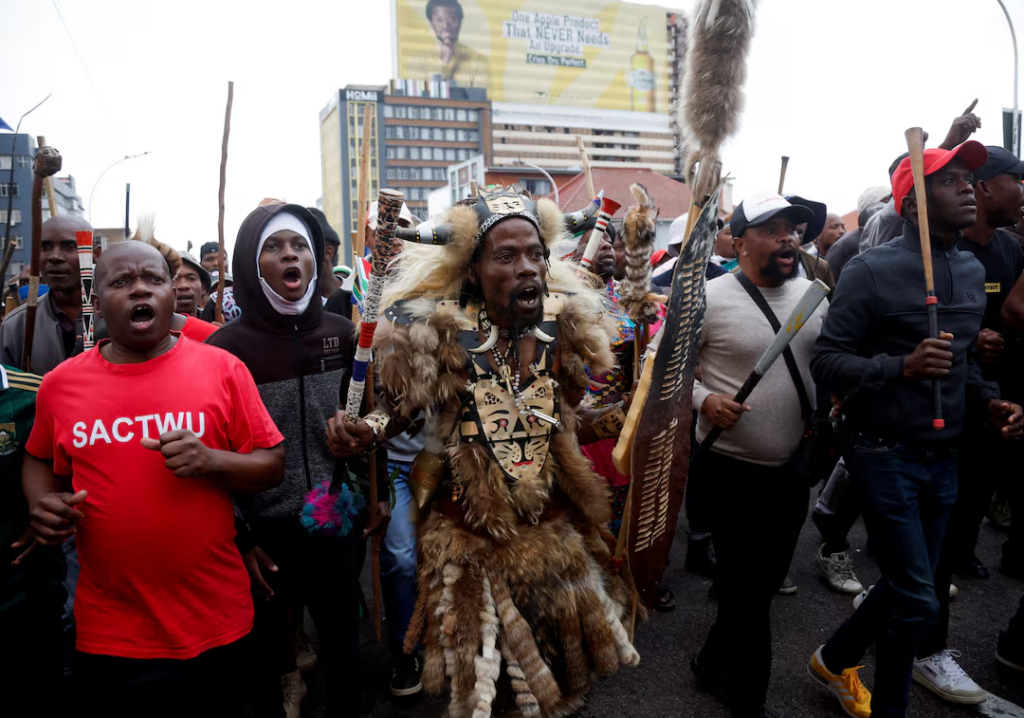
Economist and Board Chairman of MTN Ghana, Dr Ishmael Yamson, has blamed what he describes as state failure for South Africa’s economic difficulties.
He argues that the country’s problems will persist even if all foreigners leave.
He said South Africa’s decision to blame immigrants for its economic challenges was misplaced, warning that the approach could undermine efforts to deepen African integration and trade.
Speaking on Joy News’ PM Express on Tuesday, Dr Yamson said the xenophobic attacks against African migrants in South Africa were deeply troubling.
“No, what’s happening in South Africa is a big worry to many people and to me. And I know that a big worry to Ghanaians and to the government of Ghana,” he said.
Dr Yamson said he had personally raised concerns about the issue during a recent visit to South Africa, where he spoke on African integration and immigration.
“I was in South Africa three weeks ago to speak on African integration and immigration. And I minced no words,” he said.
“I told them clearly that even if all the foreigners were to leave South Africa, their problems would still remain. It’s a matter of state failure.”
He argued that South Africa had failed to manage the economy effectively and was now shifting responsibility to foreigners.
“They have badly managed their economy. Even the apartheid government left them an economy better than what they have today. And yet they now turn around and blame foreigners,” he said.
Dr Yamson also recalled Ghana’s role in supporting liberation movements across Africa, particularly during the struggle against apartheid in South Africa.
He said Ghana provided support and training for freedom fighters from several African countries, including South Africa.
“When I was growing up, the area from the new Foreign Affairs in Accra, all the way down to now Village, was called Freedom Fighters Village,” he said.
“Nkrumah built that whole area to bring freedom fighters to train in Ghana, people from Zimbabwe, from South Africa, from Uganda, from whatever. Using Ghana’s money.”
He said Ghana also provided technical support to South Africa after apartheid, citing the experience of Unilever as an example.
“For instance, the highest trained person in Unilever South Africa was a supervisor. So, we had to send people from here, Unilever Ghana, to go and help them in South Africa,” he said.
Dr Yamson said his personal experience of South Africans who had fled apartheid made the current attacks against other Africans particularly disturbing.
“I went to school with South Africans who have run away from South Africa. So, for them to suddenly rise up against Africans is something else,” he said.
He criticised the use of violence to force African migrants out of South Africa, contrasting it with Ghana’s handling of immigration concerns.
“I told them there. I said, We have experience in Ghana, but even in that, we were decent enough to give the foreigners time to either regularise their stay or leave,” he said.
“Here, you have mobs and hooligans, people you call yourself call criminals, chasing Ghanaians and Nigerians and Zimbabweans and Ugandans, and and and violently to send them away. No, it’s bad.”
Dr Yamson warned that the attacks also expose a contradiction in Africa’s push for deeper economic integration.
He questioned how the continent could achieve meaningful trade integration while restricting the movement of people.
“And at the same time, you are talking about African Free Trade Continental whatever, whatever area. So, the trade will come with what, horses and ships?” he asked.
“How do you trade without people? You cannot trade without people. You want the trade, but you don’t want the people who bring the trade.”
DISCLAIMER: The Views, Comments, Opinions, Contributions and Statements made by Readers and Contributors on this platform do not necessarily represent the views or policy of Multimedia Group Limited.
DISCLAIMER: The Views, Comments, Opinions, Contributions and Statements made by Readers and Contributors on this platform do not necessarily represent the views or policy of Multimedia Group Limited.
Source link


