


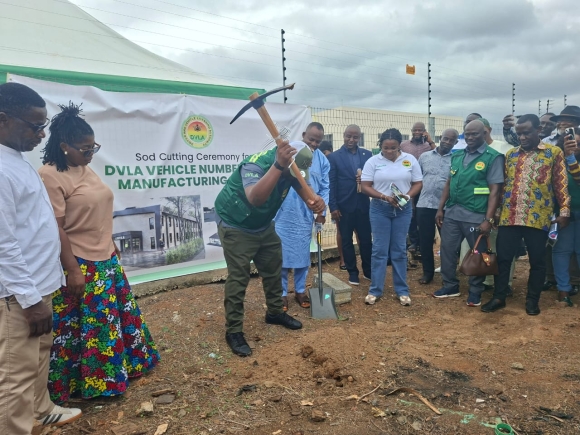
The Driver and Vehicle Licensing Authority (DVLA) is set to take full control of the production of vehicle number plates in Ghana, ending its reliance on imported plates and third-party manufacturers.
The move is part of a major transformation of the authority’s operations aimed at tightening security around vehicle identification and tackling the growing problem of counterfeit number plates.
As a first step, the DVLA has commenced construction of a vehicle number plate manufacturing centre at its Greater Accra regional office in Accra.
The facility is expected to be completed within three months and will produce number plates fitted with Radio Frequency Identification (RFID) technology.
The Chief Executive Officer (CEO) of the DVLA, Julius Neequaye Kortey, performed the sod-cutting ceremony for the project on Friday, August 28, 2026, signalling the formal commencement of construction.
Mr Kortey said the initiative formed part of broader reforms to reposition the DVLA and strengthen the integrity of vehicle registration and identification in the country.
“The sod that has been cut today demonstrates the government’s commitment to reposition the DVLA as a key institution in the road transport sector,” he said.
He said the establishment of the facility would enable the authority to produce high-quality number plates under its direct supervision while helping to curb the circulation of fake plates.
The initiative is also expected to reduce the authority’s dependence on external suppliers and give it greater control over the quality, security and distribution of number plates.
Plates to be made locally
Under the new arrangement, number plates manufactured at the centre will be distributed to DVLA offices across the country for embossment.
Mr Kortey said the arrangement would decentralise the service and make it more accessible to vehicle owners.
“When we manufacture our plates, we will distribute them to our offices for embossment,” he said.
He explained that each region would be equipped with an embossment machine to support the decentralised system.
The Greater Accra and Ashanti regions, which record significant volumes of vehicle registrations, will receive five and three machines, respectively.
The DVLA CEO said the planned changes represented a significant departure from the existing system, under which number plates were imported or produced by third parties.
He said the authority’s objective was to establish a more secure and controlled system in which the production and embossing of vehicle number plates could be properly regulated.
Regulation of embossers
Mr Kortey stressed that the move should not be interpreted as an attempt by the DVLA to eliminate private embossers from the sector.
Rather, he said, the authority would regulate their activities to ensure that only qualified operators were involved in the production and embossing of approved number plates.
“What we are saying is that the era where anyone gets the means to manufacture or emboss number plates is a thing of the past. DVLA will regulate embossers to do things right,” he said.
He said the distribution of embossment machines across the country would help ensure that vehicle owners received standardised and quality number plates while limiting opportunities for unauthorised production.
Security concerns
The project comes against concerns over the quality of some number plates currently in circulation and the presence of counterfeit plates within the vehicle registration system.
The introduction of RFID-enabled plates is expected to provide an additional layer of security and improve the integrity of vehicle identification.
The DVLA believes that taking greater control of the manufacturing process will make it more difficult for unauthorised persons to reproduce official number plates.
The project therefore forms part of the Authority’s broader effort to modernise its operations, strengthen regulation and improve service delivery in Ghana’s road transport sector.
DISCLAIMER: The Views, Comments, Opinions, Contributions and Statements made by Readers and Contributors on this platform do not necessarily represent the views or policy of Multimedia Group Limited.
DISCLAIMER: The Views, Comments, Opinions, Contributions and Statements made by Readers and Contributors on this platform do not necessarily represent the views or policy of Multimedia Group Limited.
Source link


