


The Judicial Service has reaffirmed Chief Justice Paul Baffoe-Bonnie’s commitment to the integrity and independence of the Judiciary amid growing public criticism of comments he made about the performance of some state-owned institutions.
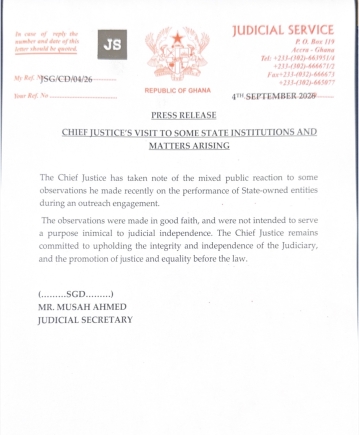
In a statement issued on Friday, September 4, the Judicial Service said the Chief Justice had taken note of the “mixed public reaction” to observations he made during a recent outreach engagement.
It stressed that the comments were made in good faith and were not intended to undermine the independence of the Judiciary.
“The Chief Justice remains committed to upholding the integrity and independence of the Judiciary, and the promotion of justice and equality before the law,” the Judicial Service said.
The clarification follows criticism of comments made by the Chief Justice during visits to the Social Security and National Insurance Trust (SSNIT) and the Minerals Income Investment Fund (MIIF) on Wednesday, September 2.
At MIIF, Justice Baffoe-Bonnie praised the institution and other public entities for what he described as improvements in their operations, saying the developments had left him questioning Ghana’s performance over the previous eight years.

“I must congratulate you. I mean, you have done marvellously well. See, because sometimes when we hear the things that you have done, the things that some organisations are doing now, we wonder; some of us keep wondering what really we have been doing in the past eight years,” he said.
Read Also: Chief Justice praises MIIF, other SOEs, questions what Ghana was doing in past 8 years
He also contrasted SSNIT’s current operations with previous attempts to dispose of some of its assets, including the Labadi Beach Hotel.
The remarks have since triggered a debate over whether the Chief Justice’s comments amounted to political commentary and whether they could affect public perceptions of the Judiciary’s neutrality.
Concerns over perceived bias
The opposition New Patriotic Party (NPP) has been particularly critical of the comments, accusing the Chief Justice of entering the political arena and questioning his ability to preside impartially over politically sensitive cases.
The party subsequently called for his resignation, arguing that his comments appeared to favour the governing National Democratic Congress (NDC).
Manhyia South MP and member of Parliament’s Constitutional and Legal Affairs Committee, Nana Adjei Baffour Awuah, also described the comments as an “unfortunate indiscretion” and argued that the Chief Justice’s official position made the remarks particularly concerning.
Governance watchdog, the Ghana Centre for Democratic Development (CDD-Ghana), meanwhile urged the Chief Justice to exercise restraint and discretion in his public engagements to protect the perceived impartiality and credibility of the Judiciary.
CDD-Ghana said the concern was not necessarily about the Chief Justice having views on the performance of public institutions, but about the potential effect of his public commentary on perceptions of judicial independence and impartiality.
Political activist and physician Dr Arthur Kobina Kennedy similarly criticised the Chief Justice, arguing that his comments were inappropriate for the head of the Judiciary and made him sound like a political actor.
Defenders say comments were not necessarily political
The comments have, however, received support from some commentators.
President of IMANI Africa, Franklin Cudjoe, rejected the suggestion that the Chief Justice had necessarily made a political statement, arguing that the performance of state institutions could be assessed objectively using available data.
“Is it not the truth that some of these state institutions are performing better? Come on, just look at the data,” he said on Joy FM’s Midday News. “Did he lie? I mean, did he lie?”
NDC Deputy General Secretary Mustapha Gbande has also rejected the NPP’s demand for the Chief Justice’s resignation, insisting that the comments did not justify such a call.
NDC lawyer and communication team member Hamza Suhuyini has further defended the Chief Justice’s engagements with state institutions, arguing that building working relationships with public institutions falls within the broader responsibilities of his office.
DISCLAIMER: The Views, Comments, Opinions, Contributions and Statements made by Readers and Contributors on this platform do not necessarily represent the views or policy of Multimedia Group Limited.
DISCLAIMER: The Views, Comments, Opinions, Contributions and Statements made by Readers and Contributors on this platform do not necessarily represent the views or policy of Multimedia Group Limited.
Source link


