


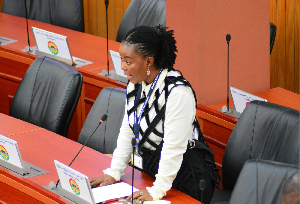

The Member of Parliament for Ablekuma North, Ewurabena Aubynn, has called for stronger enforcement of disability accessibility standards and increased investment in inclusive education as Ghana joins the world to mark the 2025 International Day of Persons with Disabilities.
Delivering a statement in Parliament on Wednesday December 3, 2025, the MP highlighted this year’s global theme, “Fostering disability-inclusive societies for advancing social progress,” stressing the need for Ghana to strengthen systems and policies that ensure full inclusion and equal participation of Persons with Disabilities (PWDs) in national development.
Aubynn noted that the 2025 commemoration is historic for Ghana, which has begun implementing the Free Tertiary Education for Persons with Disabilities policy.
Launched on 25th October 2025, the policy absorbs tuition fees for all PWDs admitted to public tertiary institutions and is being executed through the Students Loan Trust Fund with support from GETFund.
She emphasised that the initiative “is not an act of charity but a fulfilment of constitutional justice, grounded in Article 25 of the 1992 Constitution and the Persons with Disability Act, 2006 (Act 715), both of which guarantee equal access to education.”
NDC’s Ewurabena Aubynn to be sworn in as MP on July 22
The Ablekuma North MP cited the 2021 Population and Housing Census, which shows that 8% of Ghana’s population about 2.1 million people live with a disability.
Disability prevalence is higher among females and more common in rural communities, where access to assistive devices and services remains limited.
Visual impairment is the most prevalent disability type.
Among the elderly, 38% live with at least one disability, increasing their risk of poverty and social exclusion.
She described the statistics as evidence of “serious socioeconomic disparities”, noting that unemployment among PWDs is nearly double the national average, while only 25–30% progress beyond basic education and fewer than 5% reach the tertiary level.
She warned that despite the progress made through the free tertiary education initiative, PWDs continue to face barriers such as inaccessible public buildings, mobility challenges, high costs of assistive devices and persistent stigma.
To ensure meaningful progress, Aubynn proposed seven key interventions:
Sustainable Financing: Continuous support to SLTF and GETFund for tuition absorption.
Strict Enforcement of Building Code: Mandatory audits to ensure compliance in all public tertiary institutions.
Assistive Technology: Provision of sign-language interpreters, Braille and audio materials and screen-reading software.
Mobility Support: Transport stipends or dedicated shuttles for PWD students.
Data Systems: Better monitoring of PWD enrolment and completion rates.
Public Awareness: Nationwide campaigns to reduce stigma and promote inclusion.
Employment Opportunities: Encouraging institutions to create fair job pathways for graduates with disabilities.
She described the free tertiary education programme as “bold and progressive,” but warned that its impact hinges on sustained policy reform and national commitment.
“Our collective responsibility, is to build a society where every Ghanaian irrespective of physical, sensory, intellectual or psychosocial disability has the environment, support and opportunity to thrive.”
AM
#TrendingGH: Extension of IGP’s contract draws praise and criticism
The wait is over! The GhanaWeb Excellence Awards 2025 is officially launched. Let’s Celebrate impact, innovation and excellence across Ghana.
Who deserves to be honoured this year?
Nominate now 👉 https://ghanaweb.com/ghanaexcellenceawards/nominate


