


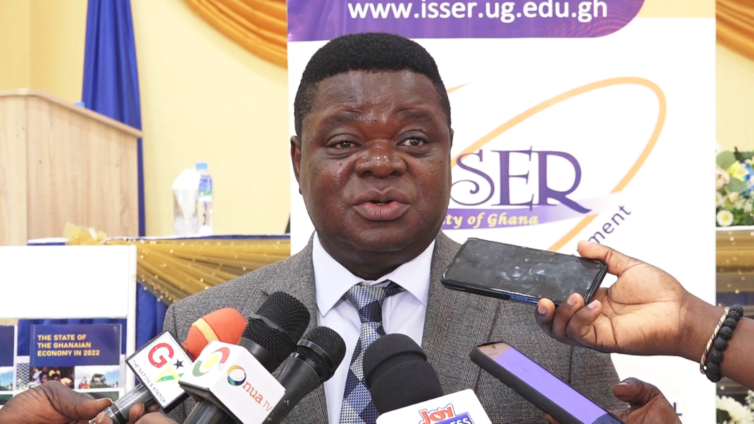
Executive Director of the Institute of Statistical, Social, and Economic Research (ISSER), Professor Peter Quartey
Economist Professor Peter Quartey has attributed Ghana’s high domestic airfares to a combination of taxes, aviation fuel costs, loans and the relatively small size of the local market.
His comments come amid growing concerns over the high cost of air travel in Ghana, with domestic passengers facing fares that can make flying less accessible.
Speaking on Joy News’ PM Express Business Edition on Thursday, Prof Quartey said the high cost of doing business extends beyond the aviation sector.
“We are not just It’s not just limited to the airline industry. If you look at our hotels, you’ll see they’re expensive. If you look at other things, rent, etc., we tend to be quite expensive,” he said.
He said Ghana’s smaller aviation market makes it difficult for airlines to benefit from the economies of scale available in larger markets such as Nigeria.
“Our market is not as huge as you would find in Nigeria,” Prof Quartey said.
“In Nigeria, there’s a lot of heavy traffic. The population is larger, and therefore, if you operate within that space, and you have more aircraft, you have competition; you are likely to charge lower.”
He also cited lower income levels as another factor limiting demand for domestic air travel.
“Most people will use road transport, trotro or buses, rather than to fly,” he said.
Prof Quartey further pointed to the age and experience of airlines operating in other markets.
“You find Ethiopian Airlines, for instance, has been in this business for a very long time; Kenya Airways has been in business for a very long time,” he said.
He said Ghana’s tax environment was also contributing to the high cost of air travel.
“Yeah, from the numbers you showed, it looks like a 20%, if you add them up straight line, a 20% tax, whereas in many African countries the average tax, VAT, is less than 15%,” he said.
“So we are taxing, overtaxing the industry. And certainly, as a business person, they will pass it on to the consumer, pass it on to us to pay.”
The economist also identified the cost of credit as another pressure on airlines.
“I know some of these airlines have borrowed, I mean they have loans that they are servicing, and they have to pay. They have to cover their costs and pay for the loans,” he said.
Aviation fuel, he added, accounts for a significant share of airline operating costs.
“Even, let’s talk about aviation fuel. Fuel accounts for about 30% of their cost,” Prof Quartey said.
“So if our fuel cost is higher compared to other countries, then certainly the cost will be higher, higher.”
He said the focus should now be on developing Ghana’s aviation market to attract more players.
“What we should be doing going forward is to develop the industry,” he said.
Prof Quartey said greater investment would come when the market becomes sufficiently attractive.
“Once there is the market, once the environment is good, once it’s profitable, every investor, businessman would like to invest in a profitable business,” he said.
“But if the market is not as huge, if we haven’t developed the market and it’s so small, and then the very few who ply that route will be charging enough to cover their cost of operations.”
DISCLAIMER: The Views, Comments, Opinions, Contributions and Statements made by Readers and Contributors on this platform do not necessarily represent the views or policy of Multimedia Group Limited.
DISCLAIMER: The Views, Comments, Opinions, Contributions and Statements made by Readers and Contributors on this platform do not necessarily represent the views or policy of Multimedia Group Limited.
Source link
