


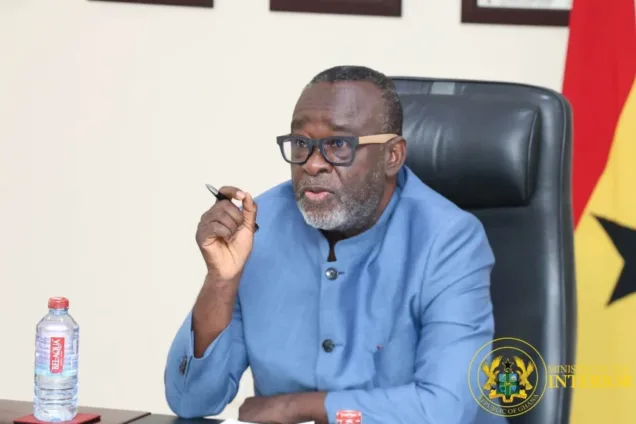
Political activist and social commentator Dr Arthur Kobina Kennedy has urged Chief Justice Paul Baffoe-Bonnie to stop touring state-owned enterprises and instead channel his energies into addressing challenges confronting Ghana’s Judiciary.
Dr Kennedy said the Chief Justice’s recent engagements with state institutions and comments on their performance were outside what he considered the proper focus of the head of the Judiciary.
“Mr Chief Justice, your place as Chief Justice is not to be touring state-owned enterprises and making the remarks that you made,” he said.
His comments follow a controversy sparked by remarks made by Justice Baffoe-Bonnie during visits to the Social Security and National Insurance Trust (SSNIT) and the Minerals Income Investment Fund (MIIF) on Wednesday, September 2.
Read Also: Chief Justice praises MIIF, other SOEs, questions what Ghana was doing in past 8 years
At MIIF, the Chief Justice praised the institution’s performance and questioned what Ghana had been doing over the previous eight years.
“Sometimes when we hear how well some state organisations are doing now, we wonder what we really have been doing in the past eight years,” Justice Baffoe-Bonnie said.
He also contrasted what he heard about SSNIT’s current operations with previous attempts to sell some of its assets, asking how Ghana could have “sunk so low”.
The comments have attracted criticism from sections of the public, with concerns that the Chief Justice’s comparison of the current and previous administrations could be interpreted as political commentary.
Dr Kennedy said rather than involving himself in debates surrounding the performance of state-owned institutions, the Chief Justice should concentrate on unresolved problems within the Judiciary.
“If you are looking for things to do, there are a lot of things you can do to improve in our judiciary,” he said.
He identified what he described as the “serpentine appellate process”, prisoners who have remained in custody for prolonged periods and whose case dockets have allegedly been lost, judicial corruption and the assignment of judicial panels among issues requiring attention.
Dr Kennedy also cited concerns about the public perception of judicial corruption, referring to Afrobarometer reports, and said other significant matters could bring the Judiciary into disrepute if not properly addressed.
“…Our serpentine appellate process, prisoners who have sat in prison forever and whose dockets have been lost, judicial corruption as has been witnessed by Afrobarometer reports, assignment of panels and other significant things that bring our judiciary into disrepute,” he said.
He urged the Chief Justice to prioritise these issues, arguing that doing so would have a more lasting impact on his tenure and legacy.
“I suggest that you focus on these things so that your legacy will be positive,” Dr Kennedy said.
He further criticised the Chief Justice’s comments as inconsistent with the dignity expected of his position.
“What you did was beneath the dignity of your office, and it did not reflect well on you or the judiciary,” he said.
Dr Kennedy’s criticism is not limited to the substance of the Chief Justice’s remarks. He also questioned the decision to undertake visits to state-owned institutions in a manner that, in his view, could blur the distinction between the Judiciary and the political branches of government.
The criticism comes amid a wider debate over judicial neutrality following the Chief Justice’s comments.
The New Patriotic Party (NPP) has accused the Chief Justice of making partisan political commentary and called for his resignation, while the governing National Democratic Congress (NDC) has rejected the demand.
The Ghana Centre for Democratic Development (CDD-Ghana) has separately urged the Chief Justice to exercise restraint and discretion in his public engagements to safeguard the impartiality and credibility of the Judiciary.
The Judicial Service, in response to the public reaction, said the Chief Justice’s observations were made in good faith and were not intended to undermine judicial independence.
It stressed that Justice Baffoe-Bonnie “remains committed to upholding the integrity and independence of the Judiciary, and the promotion of justice and equality before the law.”
For Dr Kennedy, however, the Chief Justice should demonstrate that commitment by focusing more directly on the institutional challenges within the Judiciary rather than commenting on the performance of state agencies.
DISCLAIMER: The Views, Comments, Opinions, Contributions and Statements made by Readers and Contributors on this platform do not necessarily represent the views or policy of Multimedia Group Limited.
DISCLAIMER: The Views, Comments, Opinions, Contributions and Statements made by Readers and Contributors on this platform do not necessarily represent the views or policy of Multimedia Group Limited.
Source link
