


Introducing the SRID Fieldschool and aftermath
The recent Sea-ing Africa Fieldschool and Conference held at the School of Railways and Infrastructure Development (SRID), UMaT Essikado Campus, has reignited a long-overdue discussion about the future of Ghana’s railway system. Scholars, policymakers, industry experts, and community representatives gathered to explore the historical legacy, contemporary challenges, and future prospects of Ghana’s railway and broader infrastructure systems.
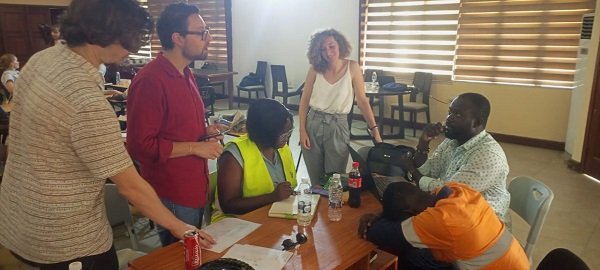
Participants engaging in group work at the FieldschoolOrganised under the theme “Sea-ing Africa: Tracing Legacies and Engaging Future Promises of ‘Big’ Infrastructure Projects in Port City Territories in Ghana and Morocco”, the conference, coordinated by Leiden University in collaboration with SRID, sought to combine academic rigor with practical policy dialogue. It aimed to examine how infrastructure projects, particularly railways, could promote inclusive economic growth, social development, and environmental sustainability.
Ideas versus execution
For decades, Ghana’s railway sector has been framed as a cornerstone of economic transformation. Strategically, railways are expected to connect farms to markets, mines to ports, and industries to business opportunities.
Yet, despite their strategic importance, the sector’s progress has been inconsistent, hindered by underinvestment, weak policy coherence, and decision-making that often excludes communities and workers most affected by projects.
Prof. Komla Tsey, a Professorial Research Fellow at Central Queensland University and Adjunct Professor at James Cook University, Australia, has argued that Ghana does not lack ideas for railway development.
What the country suffers from is a persistent inability to translate these ideas into tangible decisions that shape reality. The colonial legacy, where railways were designed for extraction rather than inclusion, continues to influence where investments go and who benefits from them.
- Dr Franceschini (second right) supervising group discussions at the Fieldschool after field trip
Railway master plan and strategic investments
The unveiling of Ghana’s Railway Master Plan and ongoing investment negotiations coincide with a critical moment in the sector’s history. Prof. Tsey noted that choices made today will define Ghana’s railway trajectory for decades.
- Participants engaging in group work at the Fieldschool
Infrastructure: More than steel and tracks
Dr. Costanza Franceschini, Coordinator of the Fieldschool and Postdoctoral Researcher in Cultural Anthropology, reminded participants that infrastructure is never merely technical. Ports, highways, and railways are embedded in social, economic, political, and cultural systems. They influence livelihoods, access to opportunities, and who gains or loses from development.
During the colonial era, railways and ports primarily facilitated the export of bauxite, gold, and cocoa. Much of this infrastructure has since fallen into disrepair, highlighting the consequences of neglect, poor maintenance, and misaligned priorities. Learning from this history is crucial if Ghana is to develop infrastructure that benefits all citizens, not just a select few.
From dialogue to decisions
A recurring theme at the Fieldschool was the need to shift from dialogue to implementation. Ghana has witnessed decades of policy dialogues that generate reports and recommendations but rarely result in action. Prof. Tsey urges smaller, targeted engagements, bringing together decision-makers, researchers, industry actors, and community representatives to focus on specific challenges and produce actionable solutions.
“These are not talk shops,” he explained. “They are working sessions designed to answer practical questions: What needs to change? Who can make that change? And how quickly?” This approach is critical if Ghana is to move past the cycle of endless discussion without results.
Strengthening community participation, improving environmental oversight, and creating opportunities for local businesses are not theoretical exercises; they are concrete measures that demonstrate inclusive and effective railway development in practice.
Media as a partner in development
The media plays a pivotal role in driving accountability and public engagement. Too often, infrastructure debates are confined to technical circles, leaving the public uninformed. Prof. Tsey proposes strategic collaboration between experts and journalists to translate ideas into narratives that are urgent, credible, and politically actionable. Through informed reporting, the media can ensure that railway reform is treated as a national priority with tangible impacts on jobs, equity, and growth.
Inclusive development: The goal of modern railways
Railways must be more than tracks and trains. They must be instruments of social inclusion and economic justice. Dr. Franceschini observes a broader shift in development thinking from large, state-led mega-projects to smaller, citizen-focused interventions that directly address local community needs. When communities are actively involved in planning and execution, projects are more sustainable, equitable, and responsive to reality.
Prof. Tsey concludes with a challenge: “If we succeed, Ghana’s railways will catalyse equitable growth, social inclusion, and economic opportunity. If we fail, we risk repeating a history of unrealised potential. The choice is ours. The time to act is now.”
The urgency of action
The SRID Fieldschool is more than an academic exercise; it is a call to action. It demonstrates the urgent need for decision-making processes that move beyond dialogue into implementation, translating recommendations into tangible results. Ghana has the intellectual capacity, technical knowledge, and policy vision to succeed in reviving its railway sector, but it also requires political will, accountability, and deliberate execution.
Railways cannot be considered mere infrastructure; they must function as economic arteries connecting communities, markets, and opportunities. Inclusive, accountable development will ensure that Ghana’s railways serve as a catalyst for growth and social justice. The lessons from SRID underline that policy alone is insufficient. Action is essential.
Conclusion: A choice for Ghana’s future
Ghana stands at a crossroads. Decisions made now will determine whether railways become engines of inclusive growth or relics of a colonial past prioritising extraction over equity. By embracing targeted decision-making, community engagement, and media accountability, Ghana can create a railway system that delivers opportunity, prosperity, and social justice.
The time for dialogue has passed. The time for action is now. Ghana must seize this moment to translate the insights from SRID into practical, measurable outcomes that redefine the future of its railways—and the nation itself.
BY CLEMENT ADZEI BOYE
Follow our WhatsApp Channel now! https://whatsapp.com/channel/0029VbAjG7g3gvWajUAEX12Q

