


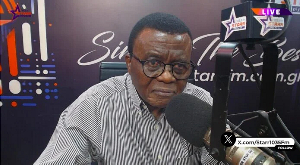
 Professor Kwaku Agyeman-Duah is a Governance analyst
Governance analyst Professor Kwaku Agyeman-Duah has openly opposed recommendations by the Constitutional Review Committee (CRC) to reduce Ghana’s minimum presidential age from 40 to 30 years.
According to him, such a change would undermine leadership maturity and weaken the country’s democratic stability.
Speaking on JoyNews on December 27, 2025, Professor Agyeman-Duah said he was personally uncomfortable with the idea, stressing that age and experience remain critical in national leadership.
“Of course, I personally didn’t like the idea of reducing the age from 40 to 30 because I think at 30 years, we don’t have enough maturity,” he argued.
He placed his argument within the Ghanaian socio-economic context, noting that many young people, especially from rural areas, complete their education later in life.
He indicated that even those who manage to complete postgraduate studies by that age may lack the practical exposure required to govern a country.
“I think if you take the Ghanaian context into account, for instance, you finish school, well, some do finish school very early, but most Ghanaians from the villages, as I come from, by the time you finish your first year, you are almost 27, 28.
“And even if by then you have finished your master’s, what experience do you have, what exposure have you had to run the country? And run the country is not running a NUGS organization,” he said.
He insisted on his belief that the age of 30 does not reflect sufficient maturity, warning that allowing leadership decisions to be driven solely by popular demand could have serious consequences for democracy.
“Knowing what I know, and at my age, I know that 30 years simply means you haven’t attained the age of maturity to run a nation, that’s what I’m talking about. At least people like you and I are providing some kind of guidance, because if democracy were to let people have what they want, we would be in chaos.
“We are going to have a chaotic situation in society. So, there’s always the need for people like you and I to provide the kind of guidance that will be needed to make sure, even if a majority of people are opposed to it, there’s a certain wisdom that will help us to move,” he stated.
Professor Agyeman-Duah also differentiated between parliamentary roles and the presidency, pointing out that the level of scrutiny and responsibility differs significantly.
He noted that members of parliament are elected by relatively small constituencies, often without deep evaluation of experience or character.
“Parliament, you are elected by your constituents, maybe 15,000 people, where there’s no real scrutiny of your character or your experience or anything. Being a parliamentarian is not the same as being the president of a sovereign nation,” he argued.
Manhyia South MP criticizes Constitution Review Committee for less focus on Judicial system
He concluded by highlighting the growing complexity of global affairs, arguing that Ghana’s president must possess a deep understanding of international relations.
“In international relations today, the changes that are occurring, what is the extent of your understanding in order to take this country to deal with the global context? So, there’s more to it,” he concluded.
MAG/EB
Christmas Festivities: Avenor traders, buyers speak on livestock sales
